
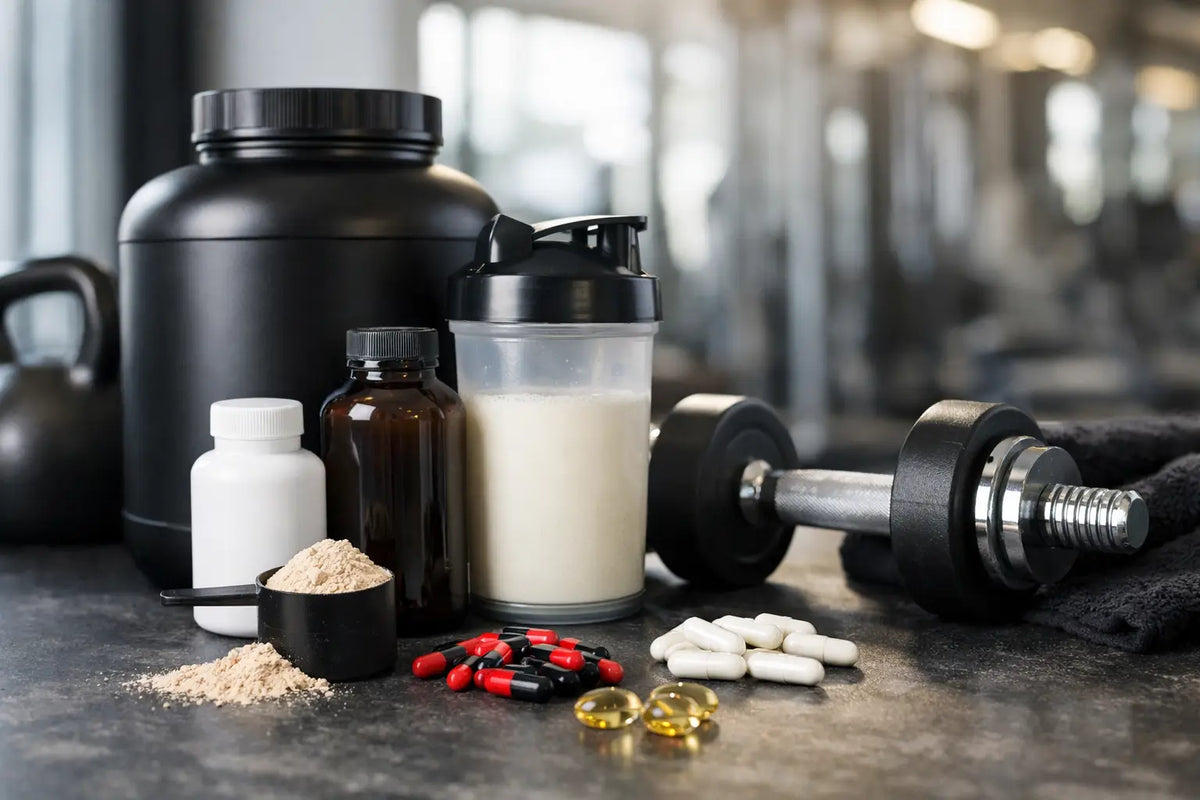
Post-training muscle damage is well-characterised at a biochemical level: exercise-induced muscle damage (EIMD) triggers an inflammatory response, elevates creatine kinase and myoglobin in the blood, and initiates protein breakdown and repair cycles. Recovery supplements work — when they are the right ones, at the right doses. This guide covers what the evidence actually supports, starting with the highest-impact interventions.
The evidence hierarchy for muscle recovery
Not all recovery supplements have equal evidence. Before the specific ingredients, here is the honest tier structure:
- Tier 1 (strong, consistent evidence): protein/amino acids, creatine monohydrate, omega-3 EPA+DHA
- Tier 2 (good evidence, more context-dependent): magnesium, electrolytes (in high-sweat conditions), tart cherry extract
- Tier 3 (plausible, limited human trial data): ashwagandha, curcumin for soreness, collagen peptides for connective tissue
Start with Tier 1 before spending on Tier 3. Most people underinvest in protein and creatine, then overspend on branded recovery blends with small doses of everything.
1. Protein — the non-negotiable foundation
Muscle protein synthesis (MPS) requires adequate leucine as a trigger and a full essential amino acid profile for completion. Without sufficient total daily protein, all other recovery supplements produce diminishing returns.
What research supports: A 2017 meta-analysis in the British Journal of Sports Medicine (Morton et al., 49 studies, n=1,863) found that protein supplementation significantly increased muscle mass and strength gains from resistance training. Effects plateaued at approximately 1.62g/kg/day of total protein. A 2013 study in the Journal of the International Society of Sports Nutrition confirmed that post-exercise protein ingestion of 20–40g containing ~3g leucine maximally stimulates MPS in most adults.
Honest limit: If you already hit 1.6–2.2g/kg/day from food, additional protein powder will not accelerate recovery further. Protein powder is a convenience tool, not a magic ingredient. Timing matters less than most people think — the post-workout window is real but not as narrow as commonly believed; total daily intake is the primary variable.
For plant-based or halal buyers, our PeaPro uses hexane-free pea protein isolation; for whey, WheyPro covers the conventional route. Full comparison in our pea vs whey guide.
2. Creatine monohydrate — recovery and performance combined
Creatine is primarily discussed for performance, but its recovery mechanism is direct: it replenishes phosphocreatine stores faster between high-intensity efforts and attenuates exercise-induced muscle damage markers.
What research supports: A 2004 study in the Journal of Strength and Conditioning Research found creatine supplementation (20g loading phase for 5 days, then 5g/day maintenance) significantly reduced post-exercise creatine kinase and lactate dehydrogenase — both markers of muscle damage — compared to placebo after repeated sprint sessions. A 2017 meta-analysis in the Journal of the International Society of Sports Nutrition confirmed creatine's effectiveness for both performance and recovery across over 300 studies. Standard maintenance dose: 3–5g/day of creatine monohydrate. No loading phase is required; it simply takes longer (3–4 weeks vs 1 week) to saturate muscle stores.
Honest limit: Creatine benefits strength and power athletes most clearly. Evidence for endurance athletes is weaker. Some people are non-responders (estimated 25–30% of the population have naturally high muscle creatine saturation). Creatine does not cause kidney damage in healthy people — this is a persistent myth. For halal sourcing, our guide to whether creatine is halal explains what to check.
3. Omega-3 (EPA and DHA) — inflammation and DOMS
Delayed-onset muscle soreness (DOMS) peaks 24–72 hours after eccentric-heavy exercise and is driven partly by the inflammatory cascade following EIMD. Omega-3s reduce prostaglandin synthesis via COX pathways — a mechanism relevant to both soreness and the quality of the repair phase.
What research supports: A 2011 RCT in Clinical Journal of Sport Medicine (Tartibian et al., n=48) found omega-3 supplementation at 1.8g EPA+DHA/day for 3 days before and after EIMD protocols significantly reduced muscle soreness and swelling vs placebo. A 2016 review in the Journal of Sports Science and Medicine confirmed anti-DOMS effects across multiple trials, with most benefits seen at 1.5–3g combined EPA+DHA/day.
Honest limit: Omega-3s work best as a daily supplement, not an acute post-workout dose. The anti-inflammatory benefit builds over weeks of consistent use. Check labels for combined EPA+DHA content, not total fish oil weight — a 1g capsule often contains only 300mg EPA+DHA. Plant-based algae oil delivers DHA without fish; comparison in our omega-3 guide.
Our OmegaBalance covers omega 3, 6 and 9 in one formula.
4. Magnesium — muscle function and sleep quality
Magnesium is EU-authorised to contribute to normal muscle function and the reduction of tiredness and fatigue. Its recovery relevance is twofold: direct role in muscle contraction/relaxation cycles, and indirect role via sleep quality, since most physical recovery happens during slow-wave sleep.
What research supports: A 2017 study in the Journal of Sports Science found magnesium supplementation (350mg/day elemental magnesium) significantly reduced muscle cramps and improved recovery markers in competitive cyclists over 4 weeks. UK dietary surveys (NDNS 2019) estimate approximately 70% of adults consume below the reference nutrient intake (300mg/day men, 270mg/day women) — making deficiency-driven impaired recovery common. For sleep relevance, a 2012 RCT in the Journal of Research in Medical Sciences showed magnesium supplementation improved sleep efficiency, sleep time and cortisol levels vs placebo.
Honest limit: Magnesium is not a primary recovery supplement — it is a foundation nutrient. Its impact is most meaningful if you are deficient. The form matters: magnesium oxide has ~4% bioavailability. Glycinate and malate are significantly better absorbed. Full breakdown in our magnesium forms guide.
5. Electrolytes — rehydration after high-sweat sessions
Electrolytes are not universally necessary for recovery — they are specifically relevant when sweat losses are significant. A short resistance session in a cool gym is not the same as a 10km run, hot yoga, or football training in summer. When sweat losses are high, electrolyte replacement directly affects muscle function, fluid retention and next-day fatigue.
What research supports: Sweat contains approximately 0.9g sodium/litre on average (though this varies significantly between individuals). A 2015 review in the British Journal of Sports Medicine found that sodium supplementation during and after prolonged exercise significantly improved fluid retention and reduced muscle cramp incidence vs water-only rehydration. A clean electrolyte formula with sodium, potassium and magnesium covers the three most exercise-relevant minerals without unnecessary sugar loading.
Honest limit: For sessions under 60 minutes of moderate intensity, plain water and dietary sodium from food are typically sufficient. Electrolyte supplements are most justified in heat, for high-sweat individuals, or for multi-session training days. More in our electrolyte powder review.
6. Tart cherry extract — DOMS and sleep (Tier 2)
Tart (Montmorency) cherry is one of the better-evidenced botanical options for recovery, with a plausible mechanism: high anthocyanin content with antioxidant and anti-inflammatory activity.
What research supports: A 2010 RCT in the Scandinavian Journal of Medicine and Science in Sports (Howatson et al., n=20) found tart cherry juice significantly reduced muscle soreness, strength loss and inflammatory markers after marathon running vs placebo. A 2014 study found tart cherry supplementation also improved sleep duration and quality, suggesting dual recovery benefit. Effective dose in trials: 30ml concentrated juice twice daily, or equivalent extract providing ~600mg anthocyanins.
Honest limit: Trials are mostly in endurance athletes after very high-volume efforts. Evidence for regular recreational strength training is thinner. Cost-to-benefit ratio is less clear than protein or creatine.
How to build a recovery stack by training type
- Strength training (3–5 sessions/week): Protein to 1.6–2.2g/kg/day + creatine monohydrate 3–5g/day. Add magnesium if sleep or fatigue is an issue. Omega-3 as a daily anti-inflammatory baseline.
- Endurance training or long runs: Electrolytes during and after + protein post-session + omega-3 daily. Tart cherry extract worth adding for high-mileage weeks.
- Mixed training or team sports: Protein + creatine + electrolytes (for training days) + omega-3. Magnesium if recovery quality between sessions is poor.
- Low-frequency training (1–2 sessions/week): Protein adequacy from food is usually sufficient. Protein powder only if diet is consistently short. Creatine still valid for strength adaptations.
Browse the full Sports Nutrition UK collection for halal-friendly, clean-label options with declared doses.
What supplements cannot fix
Supplements do not override poor sleep, chronic under-eating, or insufficient rest days. If you are training hard on five hours of sleep, no recovery stack will compensate. The biggest recovery lever for most people is not a supplement — it is total daily protein and total sleep hours. Fix those first, then layer supplements on top.
How much protein do I need after training for muscle recovery?
The evidence supports 20–40g of protein per meal, containing approximately 3g of leucine, to maximally stimulate muscle protein synthesis in most adults. Over the full day, 1.6–2.2g/kg/day of total protein is the range supported by meta-analyses for optimising muscle repair and growth. The precise post-workout timing matters less than hitting your daily total — though consuming protein within 2 hours of training is reasonable practice.
Does creatine help with muscle soreness specifically?
Yes, though the mechanism is indirect. Creatine supplementation has been shown to reduce post-exercise creatine kinase and lactate dehydrogenase levels — blood markers of muscle damage — after high-intensity exercise. It also helps maintain training output across sessions, which means each session causes proportionally less relative damage as fitness improves. Standard dose: 3–5g/day of creatine monohydrate. No loading phase is required, though 20g/day for 5 days accelerates the saturation timeline.
When should I take recovery supplements — before or after training?
Creatine: timing is largely irrelevant for the recovery benefit — it works via chronic saturation, not acute dosing. Take it at any consistent time daily. Protein: within 2 hours post-training is reasonable; total daily intake is more important. Omega-3: daily, with a meal containing fat for absorption; timing relative to training does not matter. Magnesium: evening is often preferred, particularly if sleep quality is part of the goal. Electrolytes: during or immediately after high-sweat sessions.
Are recovery supplements halal?
It depends on the specific product. Key things to check: gelatine capsules (often porcine or bovine — look for HPMC plant-derived capsules instead), creatine source (synthetic creatine monohydrate is typically halal; check manufacturing), whey protein source (must be from halal-slaughtered cattle). Plant-based options (pea protein, algae omega-3, synthetic creatine) are inherently free from most of these concerns. Our Sports Nutrition UK range uses HPMC capsules where applicable — check each product page for current halal and allergen statements.
How long does muscle recovery take with supplements?
DOMS typically peaks 24–72 hours after a novel or high-intensity session and resolves within 5–7 days without intervention. With appropriate protein intake, creatine saturation and omega-3 supplementation, research suggests meaningful reductions in soreness duration and magnitude — but not elimination. Creatine takes 3–4 weeks without loading (or 5–7 days with a loading phase) to saturate muscle stores and show meaningful recovery benefits. Omega-3 effects build over 4–8 weeks of daily use.
Do I need BCAAs if I already take protein powder?
Probably not. BCAAs (branched-chain amino acids: leucine, isoleucine, valine) are a subset of essential amino acids. If your protein powder already provides a full amino acid profile with adequate leucine (typically 2–3g per serving in quality products), BCAAs add no meaningful additional benefit. BCAAs are most useful in specific scenarios: training fasted with no protein intake before or after, or when you need a very light option during training and cannot stomach a full shake. For most people eating adequate protein, BCAAs are a low-priority purchase.


