Important context first: no food supplement can legally claim to help you sleep in the UK. Melatonin is a prescription-only medicine and cannot be sold in food supplements. This guide covers the evidence behind sleep-supporting botanical and nutritional ingredients, what they can and cannot be claimed to do, and which are halal certified.
Quick answer: the botanical and nutritional ingredients with the best sleep-adjacent evidence are: Montmorency tart cherry (natural melatonin precursors and anthocyanins that significantly improve sleep outcomes in RCTs), ashwagandha KSM-66 (cortisol normalisation that significantly improves sleep quality and onset latency), passionflower (significantly improved subjective sleep quality in a crossover RCT), and magnesium (significantly improved sleep efficiency in an RCT in older adults). All halal certified. None can legally make a sleep claim in the UK — but the clinical evidence for each is real.
Why UK supplement sleep claims are restricted
In the UK and EU, only medicinal products can make therapeutic claims like “relieves sleep disturbances.” Some UK products hold Traditional Herbal Medicine Registration (THR) — a licensed medicine route that permits this wording for valerian-based formulas. Food supplements cannot use this language regardless of their ingredients. This is consumer protection, not a reflection of whether ingredients have evidence. The practical implication: when evaluating sleep supplements, look at the evidence for each ingredient independently rather than waiting for a legal claim that cannot exist for supplements.
1. Montmorency tart cherry — natural melatonin pathway support
Montmorency cherries (Prunus cerasus montmorency) are one of the few foods that contain naturally occurring melatonin alongside its precursor tryptophan and its cofactors (B6, zinc, magnesium). They also contain high concentrations of anthocyanins with anti-inflammatory activity relevant to the neuroinflammatory component of insomnia.
What research shows: Pigeon et al. (2010, Journal of Medicinal Food, RCT) found Montmorency cherry juice significantly improved sleep time and sleep efficiency in older adults with insomnia vs placebo, with sleep extended by an average of 84 minutes. A 2012 European Journal of Nutrition RCT (n=20 healthy adults) found Montmorency cherry juice significantly increased urinary melatonin and significantly improved total sleep time, sleep efficiency and waking after sleep onset vs placebo.
2. Ashwagandha KSM-66 — cortisol-driven insomnia
The most common cause of difficulty falling asleep is elevated evening cortisol — the wired-but-tired pattern where mental activity is high but physical fatigue is profound. Normal circadian cortisol should decline sharply from approximately 4pm onwards, enabling the melatonin rise that triggers sleep. Chronic stress disrupts this pattern, keeping cortisol elevated into the evening and blocking the melatonin response.
What research shows: Langade et al. (2019, Medicine, RCT, n=60 adults with self-reported poor sleep): KSM-66 ashwagandha at 600mg daily for 8 weeks significantly improved sleep quality (PSQI score), sleep onset latency and total sleep time, and significantly improved morning alertness vs placebo. Mechanism: 23% cortisol reduction enables the normal melatonin rise. BioSnooze provides KSM-66 at 250mg per capsule (500mg at 2 capsules).
3. Passionflower — GABA modulation
Passiflora incarnata contains chrysin and other flavonoids that bind to GABA-A receptors — the same receptor class targeted by benzodiazepines, but with weak affinity and no sedative dependency risk at botanical doses. GABA is the primary inhibitory neurotransmitter that quiets neural overactivation at sleep onset.
What research shows: Ngan and Conduit (2011, Phytotherapy Research, double-blind crossover RCT, n=41) found passionflower tea significantly improved subjective sleep quality on a sleep diary measure vs placebo. Small but controlled study confirming the traditional evidence. BioSnooze provides organic passionflower 100mg per capsule.
4. Magnesium — the melatonin synthesis cofactor
Magnesium is a required cofactor for the HIOMT enzyme that converts N-acetylserotonin to melatonin. It is also a cofactor for NMDA receptor regulation — blocking NMDA overactivation is essential for the quiet neural state of sleep onset. Abbasi et al. (2012, Journal of Research in Medical Sciences, RCT, n=46 older adults) found magnesium supplementation significantly improved sleep efficiency, sleep time and early morning awakening vs placebo, and significantly reduced insomnia severity index score. UK NDNS data shows approximately 70% of adults consume below the RNI for magnesium — this is a prevalent deficiency directly relevant to sleep quality. Pair BioSnooze with Magnesium 3 Complex (300mg glycinate + malate + taurate) taken 30 minutes before bed for the combined cortisol, GABA and melatonin synthesis approach.
5. Lemon balm — anxiolytic botanical
Melissa officinalis has GABA transaminase inhibitory activity — it reduces the breakdown of GABA, increasing GABAergic tone. A 2004 Psychosomatic Medicine study found lemon balm significantly reduced anxiety and improved mood vs placebo. BioSnooze provides lemon balm 50mg per capsule.
Melatonin — the UK legal position
Melatonin is classified as a prescription-only medicine in the UK and cannot legally be included in food supplements. UK products sold online claiming to contain melatonin are either below a detectable threshold or are being imported outside UK regulations. BioSnooze contains no melatonin — it supports the body’s own melatonin synthesis pathway via the ingredients above rather than bypassing it with exogenous hormone.
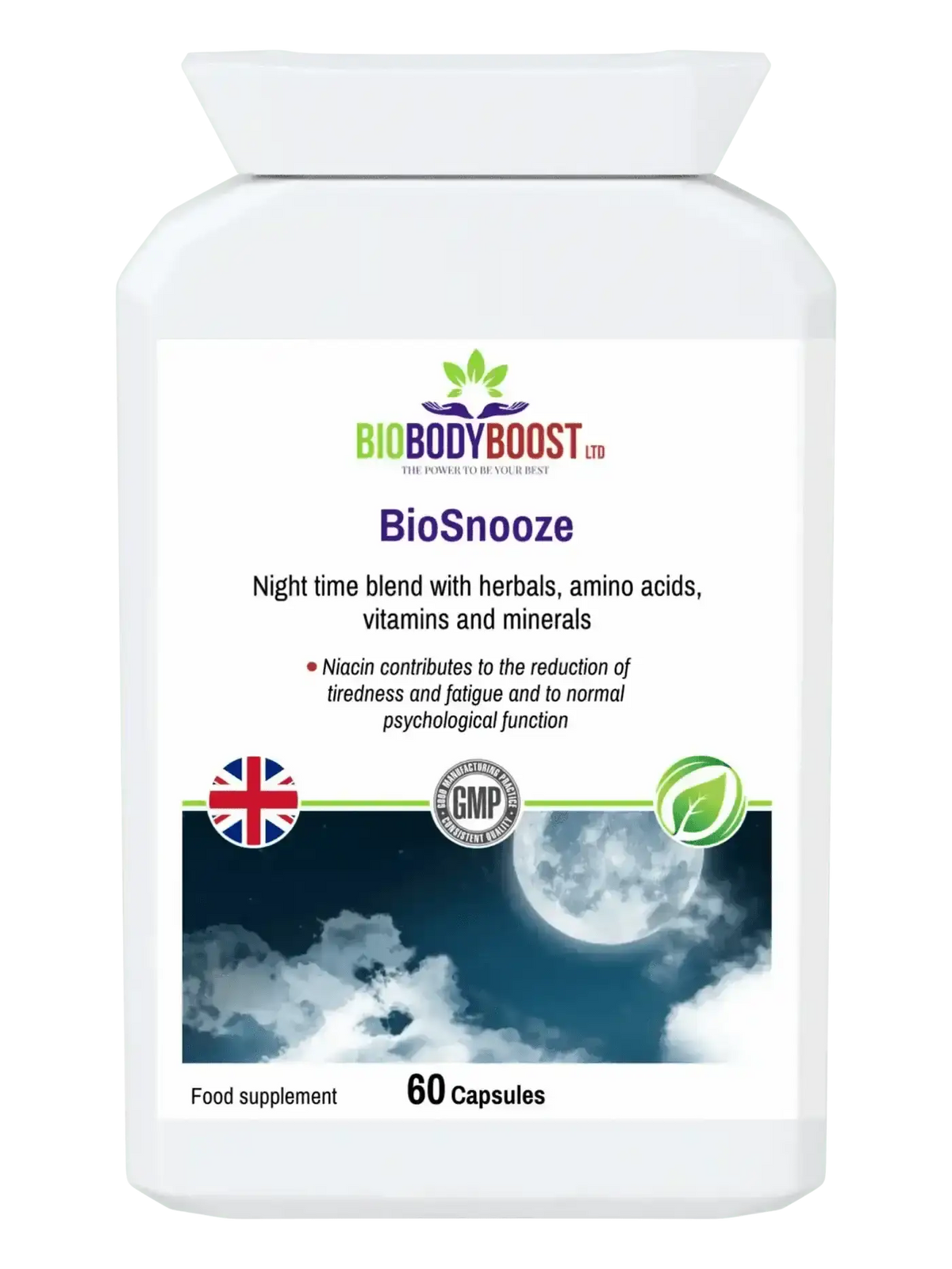
BioSnooze — KSM-66 ashwagandha 250mg, Montmorency cherry 350mg, passionflower 100mg, chamomile 50mg, lemon balm 50mg, lavender 25mg, L-taurine, L-tyrosine, niacin, B6, biotin, pantothenic acid, magnesium 50mg. Halal and kosher certified. Vegan. HPMC capsule. UK made. Take 1–2 capsules in the evening. Browse Sleep Supplements UK.
Do sleep supplements work UK?
The ingredients with the most robust human RCT evidence: Montmorency cherry (Pigeon 2010: +84 minutes sleep in insomnia; 2012 RCT: significantly increased melatonin, improved sleep efficiency), ashwagandha KSM-66 (Langade 2019: significantly improved PSQI sleep quality, onset latency and total sleep time at 8 weeks), magnesium (Abbasi 2012: significantly improved sleep efficiency, duration and insomnia severity). These are not licensed medicines and cannot claim to treat sleep disorders — but the clinical evidence for each ingredient is meaningful. For persistent or severe insomnia, the NHS recommends GP assessment and cognitive behavioural therapy for insomnia (CBTi) as the primary treatment.
Is melatonin available over the counter UK?
No — melatonin is prescription-only in the UK. It cannot legally be sold in food supplements in the UK. Some online retailers ship melatonin products from outside the UK — this is outside UK regulatory compliance. Prescription melatonin (Circadin 2mg) is available through UK GPs and is licensed for short-term insomnia in adults over 55. BioSnooze supports the body’s endogenous melatonin synthesis via Montmorency cherry, ashwagandha cortisol normalisation and magnesium (melatonin synthesis cofactor) — rather than supplementing exogenous melatonin.
Are sleep supplements halal UK?
The compliance risks in sleep supplements: gelatine capsules (common in softgel formats — check for HPMC alternative), melatonin (if present — legal concern aside, its animal-derived form is a concern for halal), flavouring systems. BioSnooze uses HPMC plant-derived capsules throughout and carries full third-party halal and kosher certification. All botanical ingredients are plant-origin. No melatonin, no gelatine, vegan throughout.