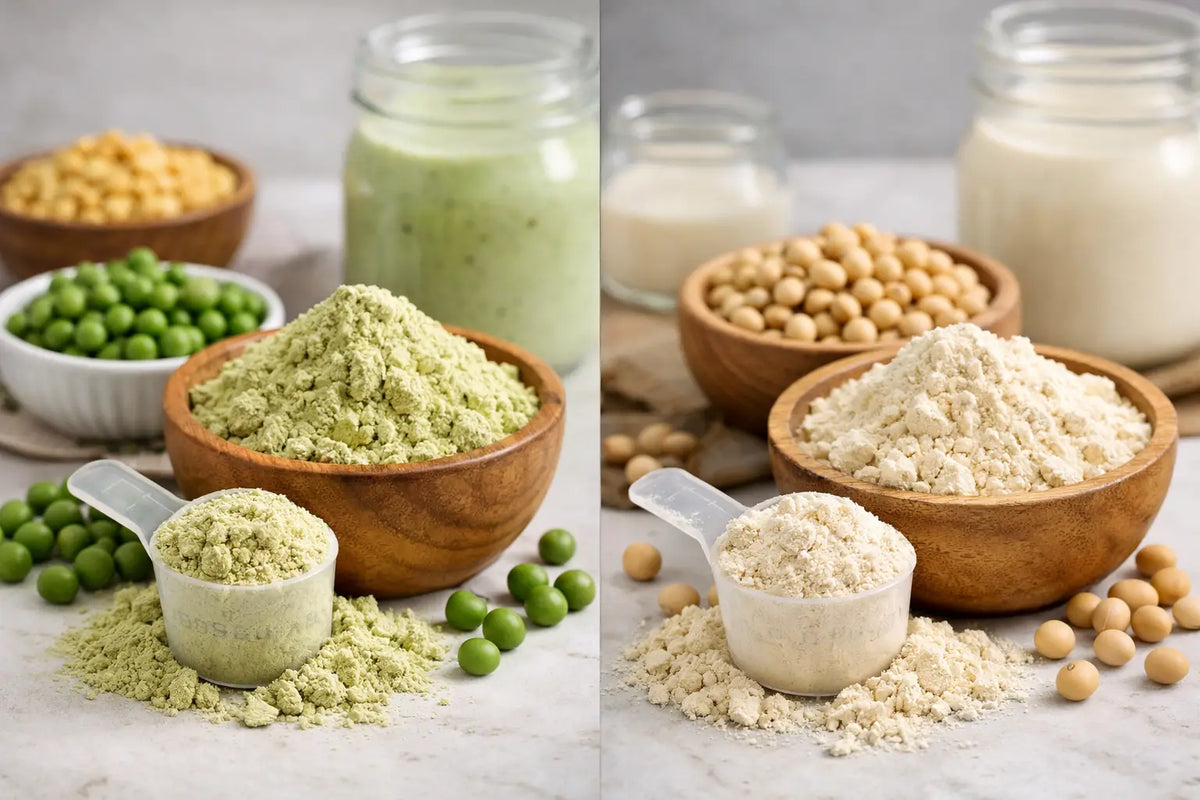
Quick answer: soy protein is a complete protein (PDCAAS 1.0) with a slightly superior amino acid profile; pea protein scores 0.82–0.89 PDCAAS, primarily due to lower methionine. At adequate doses both produce equivalent muscle hypertrophy in RCTs. Pea protein has significantly fewer allergen concerns and no phytoestrogen content. Soy is unsuitable for anyone with a soy allergy (a major EU/UK allergen). For halal buyers, pea protein is more straightforward than soy.
Protein quality: PDCAAS and DIAAS explained
PDCAAS (Protein Digestibility-Corrected Amino Acid Score) is the standard measure of protein quality, scored 0–1.0 where 1.0 indicates the protein meets or exceeds human amino acid requirements after accounting for digestibility.
- Soy protein isolate: PDCAAS 1.0 — the only plant protein considered complete by this measure, equivalent to whey and egg
- Pea protein isolate: PDCAAS 0.82–0.89 (varies by source and processing) — strong overall profile, limited primarily by methionine and cysteine content
- Brown rice protein: PDCAAS ~0.47 — significant lysine limitation; improves substantially when combined with pea (70:30 ratio achieves near-complete profile)
DIAAS (Digestible Indispensable Amino Acid Score) is a newer, more accurate measure that does not cap at 1.0. Soy protein isolate scores approximately 0.98 DIAAS; pea protein concentrate approximately 0.82. The practical difference at adequate doses is small — but matters more in people with very high protein requirements (elite athletes, older adults with sarcopenia risk) where amino acid completeness at each meal has greater impact.
The methionine gap: what it means in practice
Pea protein's lower methionine is the primary source of its PDCAAS gap. Methionine is an essential amino acid involved in protein synthesis, methylation reactions and glutathione production. The shortfall is approximately 0.3–0.5g methionine per 25g serving vs whey or soy.
For most people eating a varied diet, this gap is closed by dietary methionine from grains, eggs, dairy, meat or fish. For fully plant-based athletes relying on pea as a primary protein source:
- Combining pea with brown rice protein (70:30) produces a full amino acid profile matching whey concentrate — rice protein is high in methionine and cysteine
- Including other methionine-rich plant sources daily (sesame seeds, brazil nuts, tofu, oats) substantially reduces the practical gap
The gap is most meaningful for people eating a very restricted range of plant foods. For someone eating 80–100g+ protein/day from varied sources, pea protein's methionine shortfall per serving is clinically insignificant.
Head-to-head muscle building: what the trials show
Babault et al. (2015), Journal of the International Society of Sports Nutrition (n=161): 12-week double-blind RCT comparing pea protein (25g twice daily), whey protein (25g twice daily) and placebo in resistance-training males. Bicep muscle thickness increased significantly in both pea and whey groups vs placebo, with no statistically significant difference between pea and whey. Soy was not included in this specific trial.
Soy vs whey (Lynch et al., 2020, Journal of the International Society of Sports Nutrition): meta-analysis of 9 RCTs comparing soy and whey protein supplementation found no statistically significant difference in lean mass gains between soy and whey over matched time periods and doses.
Honest limit: the Babault trial used 50g pea protein/day (25g twice daily) — above many people's typical supplementation pattern. At lower doses where leucine threshold per serving is not met (≤2g leucine per serving from any source), MPS stimulation is suboptimal regardless of protein type. Most 20–25g servings of quality pea or soy isolate provide 1.7–2.3g leucine — at or near the ~2g threshold for meaningful MPS stimulation.
Phytoestrogens in soy: what the evidence actually shows
Soy contains isoflavones (genistein, daidzein) — phytoestrogens that bind oestrogen receptors but with approximately 1,000–10,000x lower activity than endogenous oestrogen. This has generated substantial concern about feminising effects in men and hormonal disruption in women, but the clinical evidence does not support these concerns at dietary doses:
Men: A 2010 meta-analysis in Fertility and Sterility (Hamilton-Reeves et al., 15 placebo-controlled studies) found no significant effects of soy protein or isoflavone supplementation on testosterone, free testosterone, sex hormone-binding globulin or oestrogen in men. A 2021 meta-analysis in Reproductive Toxicology confirmed no clinically meaningful hormonal effects of soy supplementation in healthy men at typical dietary doses.
Women: Soy isoflavones have been studied for menopausal symptom management with modest positive effects. No evidence of harm from dietary soy intake in premenopausal or postmenopausal women in multiple systematic reviews.
Thyroid concerns: soy isoflavones may inhibit thyroid peroxidase at high doses. A 2006 review in Thyroid found that in people with adequate iodine intake and normal thyroid function, soy does not cause hypothyroidism. People with pre-existing hypothyroidism taking levothyroxine should take their medication at least 4 hours away from soy, as soy reduces levothyroxine absorption.
Honest limit: the research is reassuring for typical dietary and supplement doses. People with diagnosed thyroid conditions should take note of the timing interaction. Very high isoflavone supplementation (above 150mg isoflavones/day — significantly more than found in a standard protein serving) has less studied safety in reproductive health contexts.
Allergen status
Soy is one of the 14 major allergens listed under UK/EU food labelling regulations (Regulation EU 1169/2011, retained in UK law post-Brexit). Soy allergy affects approximately 0.4% of children (many outgrow it) and is less common in adults, but soy sensitivity (non-allergic intolerance) is more widespread and may cause digestive discomfort, bloating or skin symptoms.
Pea protein is not on the major allergen list. It is not a common allergen in the general population. However, pea is a legume — people with multiple legume sensitivities (peanut, lentil, soy) may also react to pea, and those with confirmed peanut allergy should discuss pea protein with an allergist before use, as cross-reactivity has been reported in rare cases.
Digestibility and GI comfort
Both proteins are generally well tolerated, but relevant differences:
- Pea protein: naturally dairy-free, gluten-free, not a major allergen. Lower in FODMAPs than whole peas (processing removes most fermentable carbohydrates from isolate). A 2020 study in JISSN (Fouré et al.) found pea protein isolate was well tolerated with no significant GI adverse events over 8 weeks in healthy adults.
- Soy protein concentrate (lower processing than isolate) retains more oligosaccharides and may cause more GI symptoms. Soy protein isolate removes most of these in processing and is generally better tolerated.
- Soy contains compounds that may mildly inhibit trypsin (a digestive enzyme) — trypsin inhibitor content is substantially reduced by heat processing used in isolate production but not eliminated entirely.
Halal and vegan considerations
Both pea and soy protein are plant-derived and inherently halal and vegan by ingredient. The relevant checks are:
- Capsule or format: powders in sachets/tubs avoid capsule concerns. Products in capsules need HPMC (plant-derived) confirmation.
- Manufacturing environment: halal certification of the manufacturing facility confirms no cross-contamination with haram ingredients.
- Processing: hexane extraction is sometimes used in soy isolate production — check for hexane-free processing if this is a concern. Reputable brands disclose this. Pea protein is almost universally produced via water-based wet fractionation without solvents.
Our PeaPro is hexane-free pea protein isolate, halal certified, kosher, vegan and UK GMP manufactured. Browse the full Protein Powders collection.
Is pea protein or soy protein better for building muscle?
At adequate doses, both produce equivalent results. The 2015 Babault RCT (n=161) found no significant difference between pea protein and whey for muscle hypertrophy. The 2020 Lynch meta-analysis found no significant difference between soy and whey. Since pea and soy are both below whey by small margins, the practical implication is that either can support effective muscle building when total daily protein reaches 1.6–2.2g/kg/day and each serving provides at least 20–25g protein with ≥2g leucine. Soy has a marginally better amino acid profile (PDCAAS 1.0 vs 0.82–0.89 for pea) but this gap is clinically insignificant in the context of a varied diet.
Does soy protein affect testosterone?
No, at typical dietary and supplement doses. A 2010 meta-analysis (Hamilton-Reeves et al., 15 studies) found no significant effects of soy protein or isoflavone supplementation on testosterone, free testosterone or oestrogen in men. A 2021 meta-analysis confirmed this finding. The concern stems from soy isoflavones being phytoestrogens, but their binding affinity for oestrogen receptors is approximately 1,000–10,000x lower than endogenous oestrogen. At the amounts found in a protein supplement serving, no measurable hormonal effect in healthy men has been demonstrated in controlled trials.
Is pea protein better for digestion than soy?
Generally yes, particularly for people with soy sensitivity, irritable bowel syndrome, or multiple food intolerances. Pea protein isolate is not a major allergen, is naturally dairy-free and gluten-free, and has lower oligosaccharide content than whole peas or soy concentrate. Soy protein isolate is also relatively well tolerated, but soy is a major EU/UK allergen affecting a meaningful minority of the population. For anyone who has experienced digestive issues with soy-containing products, pea protein is the lower-risk choice.
Can I combine pea and soy protein?
Yes — but there is little nutritional reason to if you are already using one at adequate doses. Combining pea with rice protein (70:30) is the more targeted approach for improving pea protein's amino acid completeness, as rice is high in methionine and cysteine — exactly what pea is short on. Combining pea with soy does not significantly improve the amino acid profile beyond what soy alone already provides. The main reason to combine would be taste or cost, not nutritional synergy.
Is soy protein halal?
Soy is a plant-derived ingredient with no inherent halal concern. What requires checking: hexane extraction (some soy isolates use hexane as a solvent — not a halal issue per se but a clean-label concern), manufacturing environment (cross-contamination in facilities also processing animal products), and any additives in the final formula. For the strictest halal compliance, look for halal-certified soy protein from a manufacturer with declared halal production conditions. Pea protein removes the sourcing scrutiny since it is universally water-extracted and plant-origin throughout.