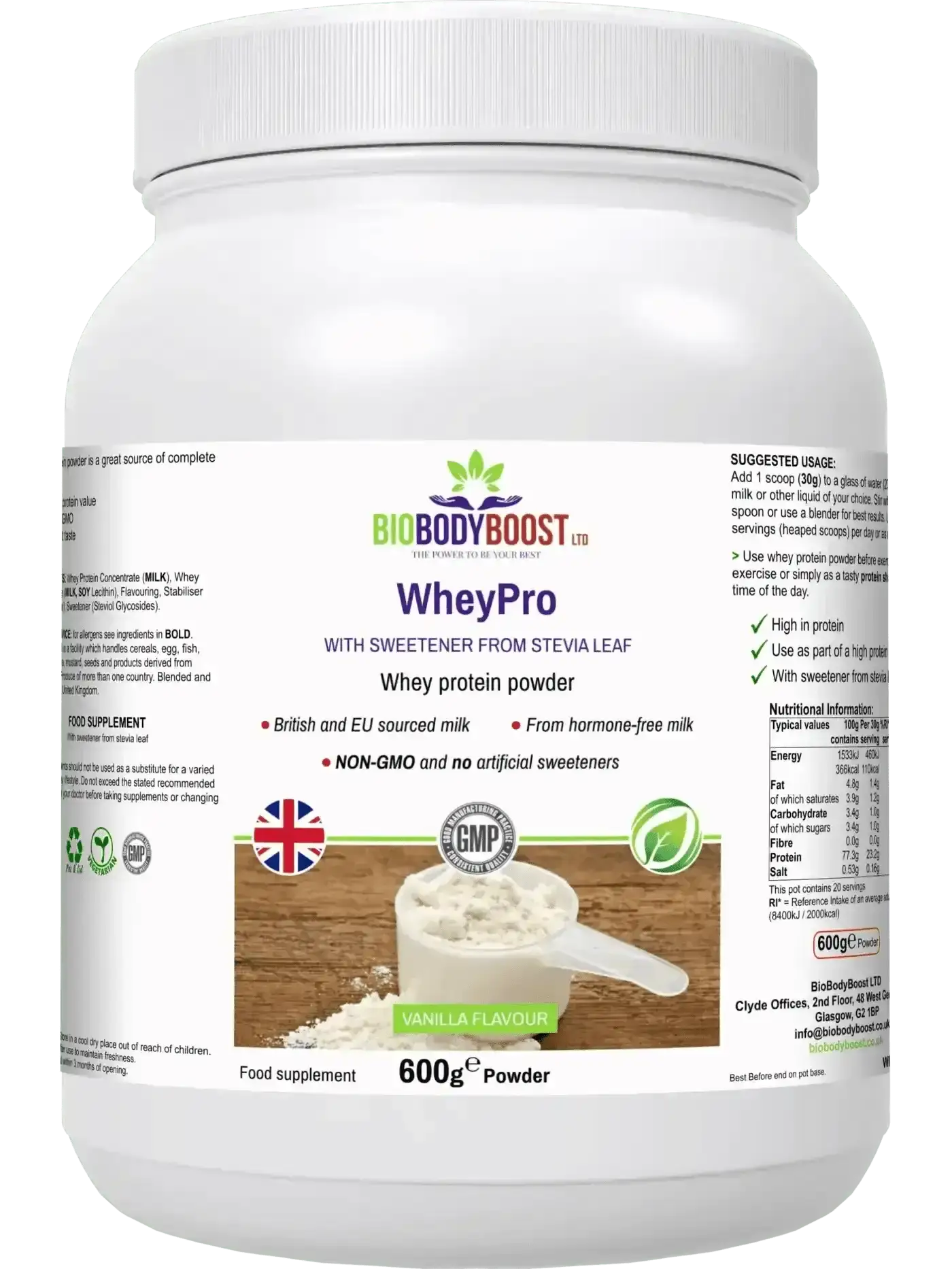
Quick answer: whey protein can be halal but most mainstream UK whey protein is not certified halal. Whey is a dairy byproduct — from milk of cows. For whey to be halal, the dairy supply chain must be from permissible sources (most Islamic scholars accept dairy from non-slaughtered animals — milking a cow does not require halal slaughter) but the manufacturing facility, processing aids and additives must also meet halal standards. The key compliance risks are the rennet used in the cheesemaking process that produces the whey, processing aids in the facility, and added flavourings that may contain alcohol-based extracts. BioBodyBoost WheyPro is halal approved — one of very few UK whey protein brands with confirmed third-party halal certification.
Why whey protein halal status is complex
Whey is separated from milk during cheesemaking. The cheesemaking process uses rennet (an enzyme that coagulates milk proteins) — rennet can be animal-derived (from calf stomach lining) or microbial/vegetarian. Animal rennet from a non-halal-slaughtered calf is the first compliance concern in the whey supply chain. Most industrial whey in the UK uses microbial rennet — but without halal certification, this cannot be confirmed from the label.
Additionally: flavouring systems for chocolate, vanilla or strawberry whey protein frequently use alcohol as a carrier solvent for flavour compounds. These trace alcohol levels (typically below 0.1%) from processing are a scholarly grey area — some scholars apply the principle that small unavoidable trace amounts do not confer the full ruling of intoxicants; others apply strict avoidance. Halal-certified whey uses only halal-approved flavouring systems.
Halal vs kosher for whey protein
Kosher and halal have different approaches to dairy. Kosher MILKY classification (whey is dairy) is not the same as halal certification. A product that is KOSHER MILKY confirms the dairy supply chain meets kosher standards but does not confirm halal. These are separate certifications from separate bodies with different requirements. A whey protein with kosher certification only is not confirmed halal.
The vegan alternative — pea protein
For UK Muslims who prefer to avoid the compliance complexity of whey: pea protein isolate is the straightforward alternative. No dairy, no rennet, no flavouring system concern, no slaughter question. Babault et al. (2015, JISSN) found pea protein at 50g/day produced equivalent muscle hypertrophy to whey protein over 12 weeks in resistance-trained men. Our PeaPro — vegan pea protein isolate, halal certified, kosher, no flavourings. Or WheyPro Vanilla — halal certified whey concentrate, 23.6g protein per serving.
Is whey protein halal?
Whey protein can be halal but requires certification at multiple levels: the rennet used in cheesemaking (microbial or halal-animal rennet), the manufacturing facility (no cross-contamination with haram substances), and flavouring systems (must not use alcohol-based carriers). Most mainstream UK whey brands (MyProtein, Optimum Nutrition, PhD, USN) do not carry third-party halal certification. BioBodyBoost WheyPro carries full third-party halal certification covering all compliance levels. For the compliance-simplest protein option, pea protein (PeaPro) is inherently halal with no supply chain complexity.
Is whey protein from pork?
No — whey protein is derived from cow’s milk, not pork. It is a dairy byproduct of cheesemaking. The porcine concern in protein supplements typically relates to gelatine (capsule shells) rather than the protein itself. However, whey produced in facilities that also process porcine products may have cross-contamination risks without halal facility certification. BioBodyBoost WheyPro is manufactured in a halal-certified UK GMP facility, confirming no porcine cross-contamination.