
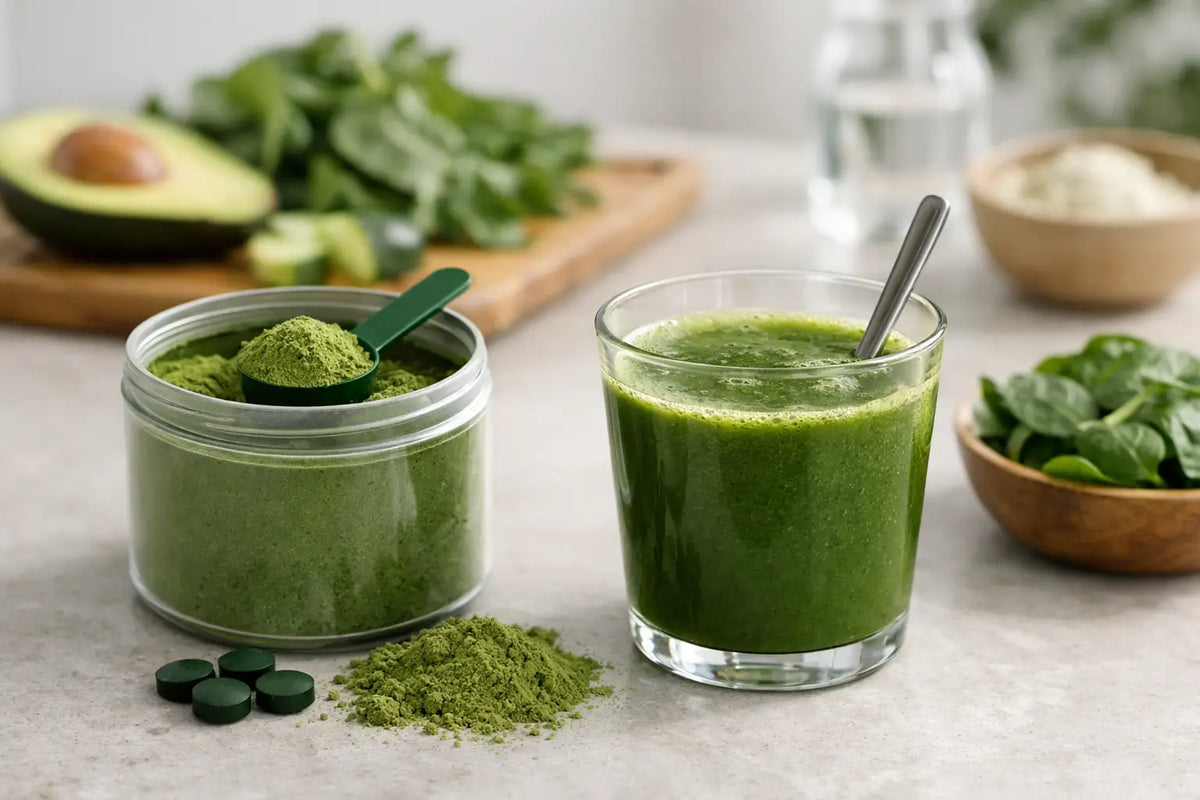
Quick answer: take greens powder once daily, mixed in cold water or a smoothie, at a consistent time you can repeat without thinking. Morning with or after breakfast is the most common and best-evidenced approach for habit formation. Timing relative to food matters less than consistency — the effect builds over weeks of daily use, not days.
When to take greens powder: what actually matters
There is no clinical trial comparing morning vs afternoon greens powder intake, because the question has not been studied directly. What is well-established from habit formation research (Lally et al., 2010, European Journal of Social Psychology) is that behaviours anchored to an existing daily cue — such as breakfast, making coffee, or leaving for work — are significantly more likely to become automatic. In that study, habit automaticity plateaued at around 66 days on average, with simpler behaviours becoming automatic faster.
The practical implication: the best time to take greens powder is whichever time has an existing anchor point in your routine. For most people that is morning. The specific timing within the morning is much less important than the anchor.
Exceptions worth knowing:
- If your greens powder contains green tea extract or guarana, check the caffeine content. Products with more than 50–75mg caffeine per serving are best avoided in the 4–6 hours before sleep.
- If the formula contains high-dose vitamin C (above 500mg) or magnesium (above 200mg elemental), some people experience mild GI discomfort on an empty stomach — taking it with food resolves this in most cases.
- If the formula contains iron, take it at least 2 hours away from calcium-rich foods (dairy, fortified plant milks) and coffee, both of which significantly impair iron absorption.
What to mix greens powder with
Cold water is the fastest and cleanest option — no added calories, no prep time, no flavour interference with other ingredients. A shaker bottle (not a spoon) is essential: greens powders contain fibrous plant matter that clumps in still liquid. Shake for 15–20 seconds, drink immediately. Leaving it to sit makes the texture worse.
If the taste is too strong for plain water, these combinations consistently reduce the earthy/grassy notes without adding significant sugar:
- Unsweetened coconut water (adds natural sweetness + potassium, ~45 calories per 250ml)
- Smoothie with banana or mango (natural sweetness masks bitterness effectively; pineapple works particularly well with spirulina-heavy formulas)
- Cold pressed apple juice diluted 50:50 with water (keeps sugar intake moderate)
What to avoid:
- Hot water or coffee: Heat above approximately 40°C degrades heat-sensitive ingredients including probiotics (if present), some B vitamins, and vitamin C. If your greens powder contains live cultures, hot liquid will significantly reduce viable CFU counts.
- Milk or calcium-fortified plant milk: If the formula contains iron, calcium binds it and reduces absorption. Also tends to produce an unpleasant texture with most greens formulas.
- High-sugar juice as a daily mixer: 250ml orange juice adds ~22g sugar. Used occasionally fine; used daily it adds ~8,000kcal of sugar per year to your routine.
How much greens powder to take
Follow the serving size on the label. This is not a vague instruction — greens powders are formulated to hit specific nutrient targets at the stated serving size, and the dose-response relationship for most botanical ingredients is not linear. Doubling the serving of a formula containing spirulina, chlorella, wheatgrass, and prebiotic fibre does not double the benefit and can cause bloating, loose stools or nausea in people with sensitive digestion.
If you are new to greens powders or have a sensitive gut, start at half the stated serving for the first 5–7 days. This is particularly relevant if the formula contains:
- Inulin or FOS (fructo-oligosaccharides): fermentable prebiotic fibres that cause gas in proportion to dose, especially when introduced rapidly
- Spirulina or chlorella at high doses: both can cause loose stools initially due to their detoxification activity and fibre content
- High-dose magnesium (above 150mg elemental per serving): osmotic laxative effect at higher doses
- Probiotic blends above 5 billion CFU: initial bloating is common in week 1 as gut flora adjusts
Does greens powder replace vegetables?
No — and this is one of the most important honest limitations to understand before buying. Greens powders are concentrated supplements, not food replacements. Key differences from whole vegetables:
- Fibre: Processing removes much of the insoluble fibre from whole vegetables. A serving of greens powder typically provides 1–3g fibre vs 3–5g in a comparable volume of whole vegetables. UK adults average only 19g fibre/day against a 30g recommended intake — greens powder alone will not close that gap.
- Satiety: Whole vegetables contribute volume and chewing time that supports satiety signalling. Greens powder dissolved in water contributes neither.
- Polyphenol matrix: Some research suggests the food matrix (cell structure of whole plants) affects polyphenol bioavailability. Powdered extracts may not replicate this fully, though the evidence is mixed.
- Cost per nutrient: Whole vegetables remain cheaper per gram of actual nutrient delivered for most micronutrients.
Where greens powder is genuinely useful: filling micronutrient gaps on days when vegetable intake is low, providing convenient access to ingredients that are impractical to consume in whole food form daily (spirulina, chlorella, barley grass), and supporting specific goals like gut health or immune support with targeted botanical concentrations.
Greens powder and specific dietary needs
Halal buyers: Check the capsule or serving format — greens powders in capsule form may use gelatine (often porcine or bovine). Powders in sachet or tub form avoid this issue. Also check for any animal-derived additives in the ingredients list.
People on blood thinners (warfarin): Greens powders containing high-dose vitamin K (from spirulina, chlorella, wheatgrass, kale powder) can affect INR in people taking warfarin. Vitamin K counteracts warfarin's mechanism. If you are anticoagulated, discuss any greens supplement with your GP or anticoagulation clinic before starting.
Thyroid conditions: Cruciferous vegetables (broccoli, kale, cabbage) contain goitrogens that in large quantities may affect thyroid hormone production. Cooked whole cruciferous vegetables largely deactivate goitrogens; concentrated raw powder may not. If you have a thyroid condition, check with your GP and look for a formula that does not concentrate raw cruciferous greens at high doses.
Pregnancy and breastfeeding: Many greens powder formulas are not assessed for safety in pregnancy due to the range of botanical ingredients. Unless your GP or midwife has confirmed a specific product is safe, avoid greens powders during pregnancy and breastfeeding.
How long before greens powder produces noticeable effects
This varies by ingredient and individual, but evidence-based estimates:
- Probiotic-containing formulas: changes in bowel regularity often noticed within 1–2 weeks; full microbiome effects take 4–8 weeks
- Energy and alertness: largely driven by B vitamins and adaptogens if present; B vitamin repletion takes 2–4 weeks if you were previously insufficient
- Digestion and bloating reduction: 2–4 weeks of consistent use with appropriate initial dose titration
- Immune support markers: most studies measure outcomes at 8–12 weeks minimum
The most common reason people report greens powder not working: inconsistent use over too short a timeframe. Two weeks of every-other-day use is not a fair test of any supplement designed for daily accumulative effect.
What is the best time of day to take greens powder?
Morning with or after breakfast is the most practical choice for most people, because it anchors to an existing daily routine — habit formation research shows behaviours linked to consistent cues become automatic faster. The specific time matters less than the consistency. Exceptions: if your greens powder contains caffeine-containing ingredients (green tea extract, guarana), avoid it within 4–6 hours of sleep. If it contains iron, take it away from dairy and coffee, which reduce iron absorption.
Should I take greens powder on an empty stomach or with food?
Either works for most formulas, but with food is safer if you are unsure. Formulas with high-dose vitamin C, magnesium, or concentrated botanical extracts can cause mild nausea or GI discomfort on a completely empty stomach in some people. If your greens powder contains probiotics, food does not impair the live cultures — in fact, some research suggests taking probiotics with a meal that contains some fat improves survival through gastric acid. If you have a sensitive stomach, with food is the lower-risk starting point.
Can I take greens powder every day long term?
For most healthy adults, yes — greens powders are formulated for daily use. The caveat is checking the cumulative micronutrient load if you also take other supplements. Some greens powders add significant amounts of vitamin A (from beta-carotene or retinol), vitamin K, iron, or iodine (from seaweed/kelp). Taking multiple products that each contribute these nutrients can push totals above the EU safe upper limits over time. Check the label and add up totals across all your supplements.
Why does greens powder cause bloating?
The most common causes: prebiotic fibres (inulin, FOS) fermenting in the gut, spirulina or chlorella at higher doses, concentrated brassica (cruciferous) powders, or high-dose magnesium. Starting with half a serving for the first week and building up resolves this in most cases. If bloating persists beyond 2–3 weeks at a full serving, the formula may not suit your gut microbiome — a different product with a simpler ingredient list is worth trying. Also check whether you are taking it on an empty stomach, which can worsen GI symptoms with concentrated botanical formulas.
Can you mix greens powder with protein powder?
Yes, they are compatible. A common approach is adding a greens powder scoop to a protein shake — the protein powder (especially vanilla or unflavoured) tends to mask the earthier notes of greens. The main consideration is total serving volume: mixing two powders in 250ml of liquid can become thick and unpleasant. Use 350–500ml of liquid when combining. Also check that the combined micronutrient load from both products does not push any single nutrient significantly above recommended intakes.
Does greens powder interact with medications?
The most clinically significant interaction is with warfarin (and other vitamin K-antagonist anticoagulants): high-dose vitamin K from greens ingredients (spirulina, chlorella, kale, wheatgrass) can reduce warfarin's effectiveness and destabilise INR. People on anticoagulants should not start any greens supplement without checking with their GP or anticoagulation clinic. Other interactions to flag with your prescriber: thyroid medication (high iodine from seaweed may interfere), some chemotherapy drugs (antioxidant-rich formulas may theoretically reduce efficacy, though evidence is limited), and iron-chelating medications (vitamin C in high doses increases iron absorption).


