Written by the BioBodyBoost Team · September 2026 · Our standards →

If you've been told your blood pressure is creeping up, your cholesterol is borderline, or you just have a family history you can't ignore — the supplement aisle is confusing. Everything claims to support a healthy heart. Most of it is marketing. A handful of ingredients have genuine clinical evidence behind them.
This guide separates the two. No filler. No vague claims. Just what the research actually shows for each ingredient — and the honest limitations.
Nattokinase vs beetroot: which is better — and can you take both?
This is the comparison most readers arrive here for, so let's answer it directly. Nattokinase and beetroot are not competing options — they work on circulation through completely different mechanisms.
Beetroot works through nitric oxide: dietary nitrates relax and widen blood vessel walls, which lowers blood pressure. Its evidence is strongest for people with borderline or elevated blood pressure, and the effect appears within weeks.
Nattokinase works on the blood itself: it dissolves fibrin (the protein that forms clots) and supports your body's own fibrinolytic system. Its evidence is strongest for blood fluidity, fibrinogen reduction and clotting tendency, with a secondary blood pressure effect.
So "which is better" depends on the problem: for blood pressure specifically, beetroot has the stronger and faster-acting evidence base. For circulation and clotting tendency, nattokinase does something beetroot cannot.
Can you take nattokinase and beetroot together? Generally yes — because they act through separate pathways (fibrinolysis vs vasodilation), they are commonly combined and there is no known adverse interaction between them. The important exception: if you take warfarin or any other anticoagulant, or prescribed blood pressure medication, speak to your GP before combining them.
Timing: what time of day should you take them, and separately or together?
This is the question the comparison searches almost always lead to next, and it's rarely answered clearly. Here's the practical guidance:
- Nattokinase is best taken on an empty stomach, away from meals — dietary protein can compete with its absorption and fibrinolytic activity is generally considered strongest when taken 1–2 hours before or 2–3 hours after food. Many people take it first thing in the morning before breakfast.
- Beetroot extract has no strict timing requirement relative to food, since dietary nitrate absorption isn't significantly affected by a meal. Its blood pressure effect peaks roughly 2–3 hours after intake and lasts up to 24 hours with regular use, so consistency matters more than the exact clock time.
- Taking them together: if using both, the practical approach is nattokinase on an empty stomach in the morning, and beetroot with or after breakfast. There's no requirement to separate them by hours — this is about optimising each ingredient's own absorption, not avoiding an interaction between them.

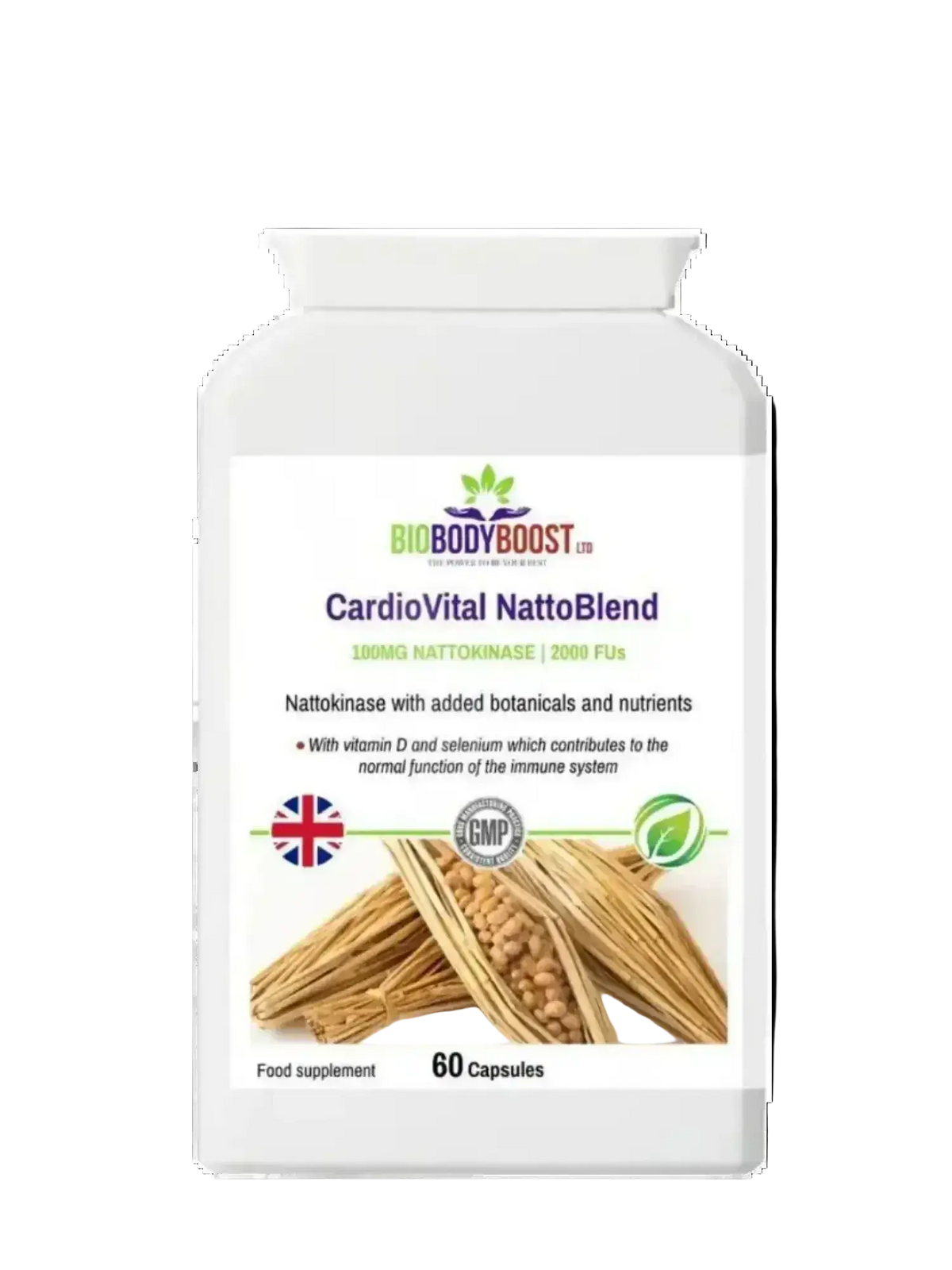
2000 FU per capsule — fibrinolytic strength declared, the detail most nattokinase labels bury or omit.
The evidence base for nattokinase specifically — what's been studied
Nattokinase has a larger and more recent clinical literature than most single-ingredient heart supplements get credit for:
- Hodis et al. (2021, Clinical Hemorheology and Microcirculation, RCT) — the Nattokinase Atherothrombotic Prevention Study — found nattokinase supplementation was associated with improvements in markers relevant to atherothrombotic risk over the study period.
- A 2022 Frontiers in Cardiovascular Medicine study involving 1,062 participants examined nattokinase's role in atherosclerosis progression and hyperlipidaemia management, one of the largest cohorts studied for this ingredient to date.
- Kurosawa et al. (2015, Scientific Reports) found a single oral dose of nattokinase measurably potentiated thrombolysis and anticoagulation markers within hours — the mechanistic basis for the interaction warning with prescribed anticoagulants.
Why this matters for the medication warning: nattokinase's fibrinolytic action isn't a marginal or theoretical effect — it measurably shifts coagulation markers. That's precisely why it should never be combined with warfarin, aspirin therapy, or other prescribed blood-thinning medication without direct medical supervision. The NHS warfarin guidance specifically advises checking any new supplement with your prescriber.
Problem: High blood pressure — beetroot extract

High blood pressure affects around 1 in 3 UK adults. Beetroot is naturally high in dietary nitrates. Your body converts these to nitric oxide — a signalling molecule that tells the walls of your blood vessels to relax. When blood vessels relax, they widen. Blood flows more easily. Pressure drops.
Multiple meta-analyses confirm beetroot supplementation produces significant reductions in both systolic and diastolic blood pressure — with effects in some studies comparable in magnitude to antihypertensive medication. The effect is dose-dependent and most pronounced in people who start with elevated blood pressure. The NHS provides guidance on blood pressure ranges and when medical treatment is needed.

2250mg beetroot + 2250mg Montmorency cherry per capsule, plus B6 at 142% NRV.
The BBB option: Red Punch — beetroot + Montmorency cherry, halal certified, vegan, UK made.
Problem: High triglycerides and vascular inflammation — omega-3
Triglycerides are a type of fat in the blood and an independent cardiovascular risk factor. Omega-3 fatty acids (EPA and DHA specifically) are the most consistently evidenced supplement for reducing them. Omega-3 also reduces platelet aggregation, lowers resting heart rate, improves arterial flexibility and has systemic anti-inflammatory effects on the vascular system. The 2019 REDUCE-IT trial showed high-dose EPA supplementation reduced major cardiovascular events by 25% in high-risk patients.
The BBB option: OmegaBalance — omega 3-6-9 balanced formula, halal certified, UK made.
Problem: Blood that clots too easily — nattokinase
Nattokinase is an enzyme from fermented soybeans. It dissolves fibrin (the protein that forms blood clots) and activates your body's own plasminogen. A double-blind, placebo-controlled trial in Hypertension Research found nattokinase over 8 weeks produced significant reductions in both systolic and diastolic blood pressure. Important: if you're on warfarin or other anticoagulants, speak to your GP before taking it.
The BBB option: CardioVital — nattokinase 2000 FU + selenium, halal certified, vegan, UK made. Please note: not suitable alongside blood pressure or blood-thinning medication, or during pregnancy or nursing — see full product label for details.
Problem: LDL oxidation, arterial inflammation — astaxanthin
LDL cholesterol only becomes a problem when it oxidises. Astaxanthin is one of the most potent natural antioxidants known — with activity 550 times greater than vitamin E in some assays. Research published in Nutrients confirmed astaxanthin reduces markers of LDL oxidation, improves endothelial function and reduces inflammatory CRP levels.
The BBB option: AstaxaKrill — krill-bound EPA/DHA + natural astaxanthin, halal certified, UK made.
Quick reference: match your concern to the supplement
| Your concern | Best ingredient | Mechanism | Evidence |
|---|---|---|---|
| High / borderline blood pressure | Beetroot extract | Nitric oxide → vasodilation | Strong |
| High triglycerides, inflammation | Omega-3 EPA & DHA | Reduces triglycerides, anti-inflammatory | Very strong |
| Poor circulation, clotting tendency | Nattokinase | Fibrin dissolution, fibrinolysis | Good |
| LDL oxidation, arterial inflammation | Astaxanthin (krill) | Antioxidant, LDL protection | Moderate-strong |
What doesn't have strong enough evidence
CoQ10 has genuine biochemical rationale but inconsistent clinical evidence for cardiovascular outcomes in healthy adults. Stronger for people on statins. Red yeast rice EU-compliant products are limited to monacolin K levels too low for clinical effect. Garlic supplements show modest blood pressure effects but inconsistent evidence.
Can heart health supplements replace blood pressure medication?
No. Supplements like beetroot and nattokinase have clinical evidence for modest blood pressure effects in the pre-hypertensive and borderline range. They are not replacements for prescribed antihypertensive medication. If your GP has prescribed blood pressure medication, continue taking it and discuss any supplementation with them before starting. The NHS recommends speaking to your GP about high blood pressure treatment.
Are heart health supplements safe to take with statins?
Omega-3 and beetroot extract are generally considered safe alongside statins. Nattokinase has anticoagulant-adjacent activity and should be discussed with your prescribing doctor if you are on any cardiovascular medication. Astaxanthin has no known statin interactions at typical supplement doses. Always inform your GP of any supplements you are taking alongside prescribed medication.
What time of day should I take nattokinase and beetroot?
Nattokinase is best taken on an empty stomach — typically first thing in the morning, at least an hour before eating — since food can interfere with its absorption. Beetroot has no strict timing requirement and can be taken with or without food; its blood pressure effect peaks 2–3 hours after intake. If taking both, nattokinase in the morning before breakfast and beetroot with breakfast is a practical approach — there's no need to space them apart for safety reasons, only to optimise each one's own absorption.
How long do heart health supplements take to work?
Beetroot's blood pressure effect is relatively fast — measurable changes in 2–4 weeks of daily use. Omega-3 effects on triglycerides typically take 6–12 weeks to reach full impact. Nattokinase fibrinolytic effects build over 8–12 weeks. These are maintenance supplements, not acute interventions. Consistent daily use over 8–12 weeks is the minimum meaningful assessment period for most cardiovascular supplements.
Are BioBodyBoost heart health supplements halal certified?
Yes — all BioBodyBoost cardiovascular supplements are halal approved, including the marine-sourced products (OmegaBalance, AstaxaKrill), which carry full supply chain halal certification covering sourcing, processing and manufacturing. All products use HPMC plant-derived capsules (not gelatine), are vegan and UK GMP manufactured. Certificate reference: UHA Ref 24623, Specialist Supplements Ltd, valid to 05/12/2026.
Explore the full range: Halal Vitamins UK · Sports Nutrition UK
Food supplements should not replace a varied diet or healthy lifestyle. This article does not constitute medical advice. If you have a diagnosed cardiovascular condition or take prescription medication — particularly anticoagulants, antihypertensives or statins — consult your GP before starting any new supplement.
BioBodyBoost — Halal Certified UK Supplements
Use code HALAL10 for 10% off your first order — halal approved under UHA Certificate Ref. 24623, vegan, UK made. Shop the full range →