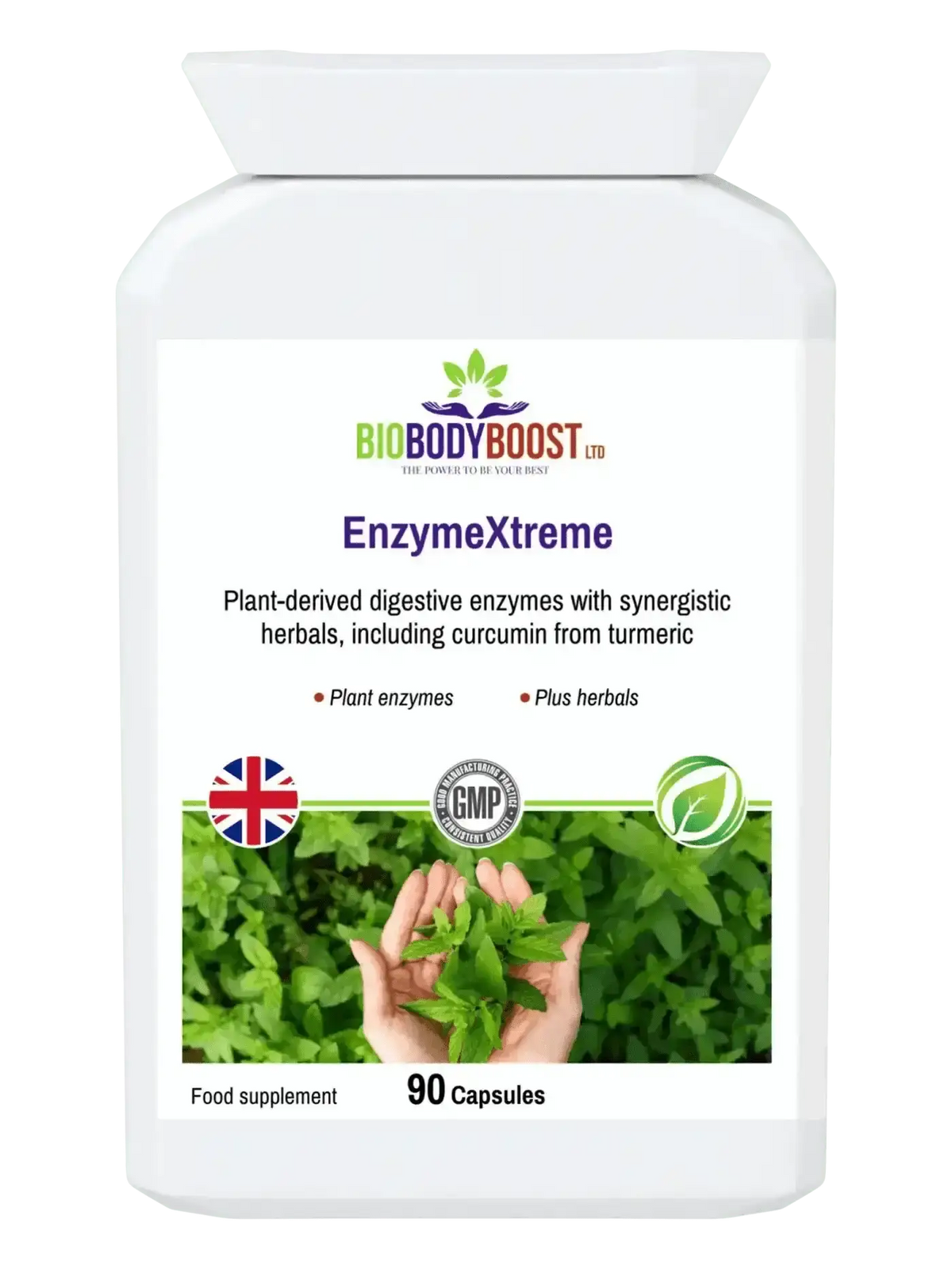
Quick answer: digestive enzymes are proteins produced by the pancreas, stomach and small intestine to break down food. Plant-derived digestive enzyme supplements (protease, amylase, lipase, bromelain, papain) support food breakdown when natural enzyme output is insufficient — particularly after the fasting window of Ramadan, after large meals, as a normal part of aging, or in people with digestive sensitivity. They are inherently halal when plant-derived. BioBodyBoost EnzymeXtreme provides a full-spectrum plant enzyme blend with turmeric and ginger, halal certified, vegan.
Why enzyme preparedness drops during Ramadan fasting
The pancreas produces digestive enzymes in response to meals — specifically in response to cholecystokinin (CCK) and secretin released by the small intestine when food arrives. During extended fasting (14–17 hours in UK Ramadan), CCK and secretin stimulation is absent, enzyme production slows, and enzyme reserves in the pancreatic acini cells are lower than during normal continuous eating. When a large Iftar meal arrives after this fasting window, the pancreas must rapidly upregulate enzyme output for a meal that is often larger, more complex and higher in fat than the person’s typical meal. This enzyme gap is the primary cause of Iftar bloating and post-meal digestive discomfort.
The enzyme types and what they do
- Protease: breaks down proteins into amino acids and peptides. Essential for meat, legume and dairy protein digestion.
- Amylase: breaks down starch (from rice, bread, lentils, potatoes) into maltose and glucose. Salivary amylase starts the process; pancreatic amylase continues in the small intestine.
- Lipase: breaks down dietary fats (triglycerides) into fatty acids and glycerol. Produced by the pancreas; bile from the liver emulsifies fat first. Fried Iftar foods make high lipase demand.
- Bromelain (from pineapple) and papain (from papaya): plant-derived proteases with anti-inflammatory properties alongside protein digestion. Both well-studied for digestive support.
Is digestive enzymes supplement halal?
Plant-derived digestive enzymes (from pineapple, papaya, aspergillus fermentation, bromelain, papain) are inherently halal — no animal involvement. Some enzyme supplements use pancreatin from porcine or bovine pancreas (not halal without certification). Always check: does the label specify “plant-derived” or “vegan” enzymes? Bromelain, papain, and Aspergillus-derived amylase/protease/lipase are the plant-origin standards. EnzymeXtreme specifies plant-derived enzymes throughout. EnzymeXtreme — full-spectrum plant enzymes with turmeric and ginger for additional digestive support. Halal certified, vegan, HPMC capsule. Take 1–2 capsules 10–15 minutes before Iftar and main meals. See the full Ramadan gut health guide.
Are digestive enzymes halal?
Plant-derived digestive enzymes are halal — bromelain (pineapple), papain (papaya) and Aspergillus-fermentation amylase/protease/lipase are all plant or fungal-origin with no animal involvement. The compliance risk is with animal-derived pancreatin (from porcine or bovine pancreas), which is used in some enzyme supplements and requires halal slaughter certification. Always look for “plant-derived,” “vegan enzymes” or an explicit halal certification on the label. EnzymeXtreme uses exclusively plant-derived enzymes with full third-party halal certification.
Why do I get bloated after Iftar?
Three main causes: (1) reduced digestive enzyme preparedness after 14–17 hours without food — the pancreas produces fewer enzymes during the fasting window, then receives a large, complex meal; (2) rapid eating at Iftar increasing swallowed air; (3) high refined carbohydrate content of typical Iftar foods (dates, bread, rice, sweets) producing rapid fermentation in the large intestine. Digestive enzymes taken before Iftar address cause 1 directly. Eating more slowly and beginning with dates then pausing before the main meal addresses causes 2 and 3.