If you've opened TikTok, walked through a health food shop, or spoken to anyone who's recently started taking supplements, you've heard it: ashwagandha. The ancient Ayurvedic herb has gone from obscure wellness niche to mainstream supplement staple — and for once, the hype is backed by the research.
In the UK alone, searches for ashwagandha supplement have grown by +32% year on year, with nearly 7 million monthly global searches now attributed to the ingredient. But with that explosion in popularity has come an avalanche of low-quality, underdosed products that promise everything and deliver very little.
This guide breaks down what ashwagandha actually does, what the clinical evidence says, what dose you need, and why the most effective approach in 2026 isn't a single-ingredient capsule — it's a stacked multi-adaptogen formula.
What Is Ashwagandha and Why Is the UK Suddenly Obsessed with It?
Ashwagandha (Withania somnifera) is a root used for over 3,000 years in Ayurvedic medicine as a rasayana — a rejuvenating tonic. Its active compounds, called withanolides, are responsible for its most studied effects: reducing cortisol, lowering perceived stress, improving sleep quality, and supporting physical endurance.
What changed is the research. A wave of double-blind, placebo-controlled human trials published between 2019 and 2025 has transformed ashwagandha from folk remedy to one of the most clinically validated adaptogens on the market.
And the timing is no accident. UK adults are under chronic stress. Long working hours, cost-of-living pressure, disrupted sleep, and digital overload have created a generation of people with chronically elevated cortisol — the stress hormone that, when persistently high, drives fatigue, weight gain, poor sleep, brain fog, and immune suppression. Ashwagandha directly addresses the root mechanism.
What the Science Actually Says: Key Clinical Findings
Here is what peer-reviewed research consistently shows when ashwagandha is taken at clinically relevant doses:
Cortisol Reduction
A double-blind, randomised controlled trial published in Medicine (2019) found that participants taking 300mg of standardised ashwagandha root extract twice daily for 8 weeks experienced a 27.9% reduction in serum cortisol compared to placebo. This is one of the most robust cortisol-lowering effects documented for any non-pharmaceutical compound.
Stress and Anxiety
A 2021 systematic review across 12 randomised controlled trials found consistent, significant reductions in self-reported stress and anxiety scores with ashwagandha supplementation. The effect was dose-dependent — those taking 600mg daily showed greater improvement than those on 300mg.
Sleep Quality
A placebo-controlled trial published in PLOS ONE (2021) found that ashwagandha root extract significantly improved sleep quality, sleep onset latency, and morning alertness in adults with insomnia. Participants taking 600mg daily reported a 72% improvement in sleep quality versus 29% in the placebo group.
Physical Performance and Recovery
Research published in the Journal of the International Society of Sports Nutrition found that ashwagandha supplementation over 8 weeks significantly increased VO2 max, muscle strength, and reduced exercise-induced muscle damage — making it uniquely effective for both stress support and athletic recovery.
Cognitive Function
A study in the Journal of Dietary Supplements found significant improvements in reaction time, cognitive flexibility, and information processing speed after 14 days of ashwagandha supplementation, attributed to its neuroprotective withanolide content.
The Dose Problem: Why Most UK Ashwagandha Supplements Don't Work
The vast majority of affordable ashwagandha products on the UK market contain 100–200mg per capsule — a fraction of the 300–600mg per day used in clinical trials. At sub-therapeutic doses, you're unlikely to experience meaningful cortisol reduction or sleep improvement.
What to look for:
- Minimum 300mg per serving of root extract
- Standardised withanolide content (5% or higher)
- Root extract, not leaf — the root is where the clinically validated compounds are concentrated
Why Stacking Adaptogens Outperforms Single-Ingredient Ashwagandha
The emerging consensus is that adaptogen stacking — combining complementary herbs that work on different mechanisms of the stress response — produces significantly better outcomes than single-ingredient supplementation.
Chronic stress dysregulates the HPA axis (hypothalamic-pituitary-adrenal axis) at multiple points simultaneously. A single ingredient like ashwagandha addresses cortisol output effectively, but combining it with herbs that modulate neurotransmitter balance, support adrenal function, and enhance cognitive performance creates a multi-mechanism effect.
The Evidence-Backed Stack: Ashwagandha + Rhodiola + Ginseng
Rhodiola Rosea is an Arctic adaptogen with UK searches growing at +173% year on year. Clinical trials show it reduces mental fatigue under stress and improves cognitive performance during sustained mental effort — complementary to ashwagandha's cortisol-lowering effects.
Siberian Ginseng (Eleuthero) has been studied for its ability to increase resistance to physical and mental stressors, reduce adrenal fatigue, and support immune function during periods of high demand.
Together, these three adaptogens address stress, fatigue, cortisol, cognitive performance, and recovery simultaneously.
ZenBlend: BioBodyBoost's Multi-Adaptogen Approach
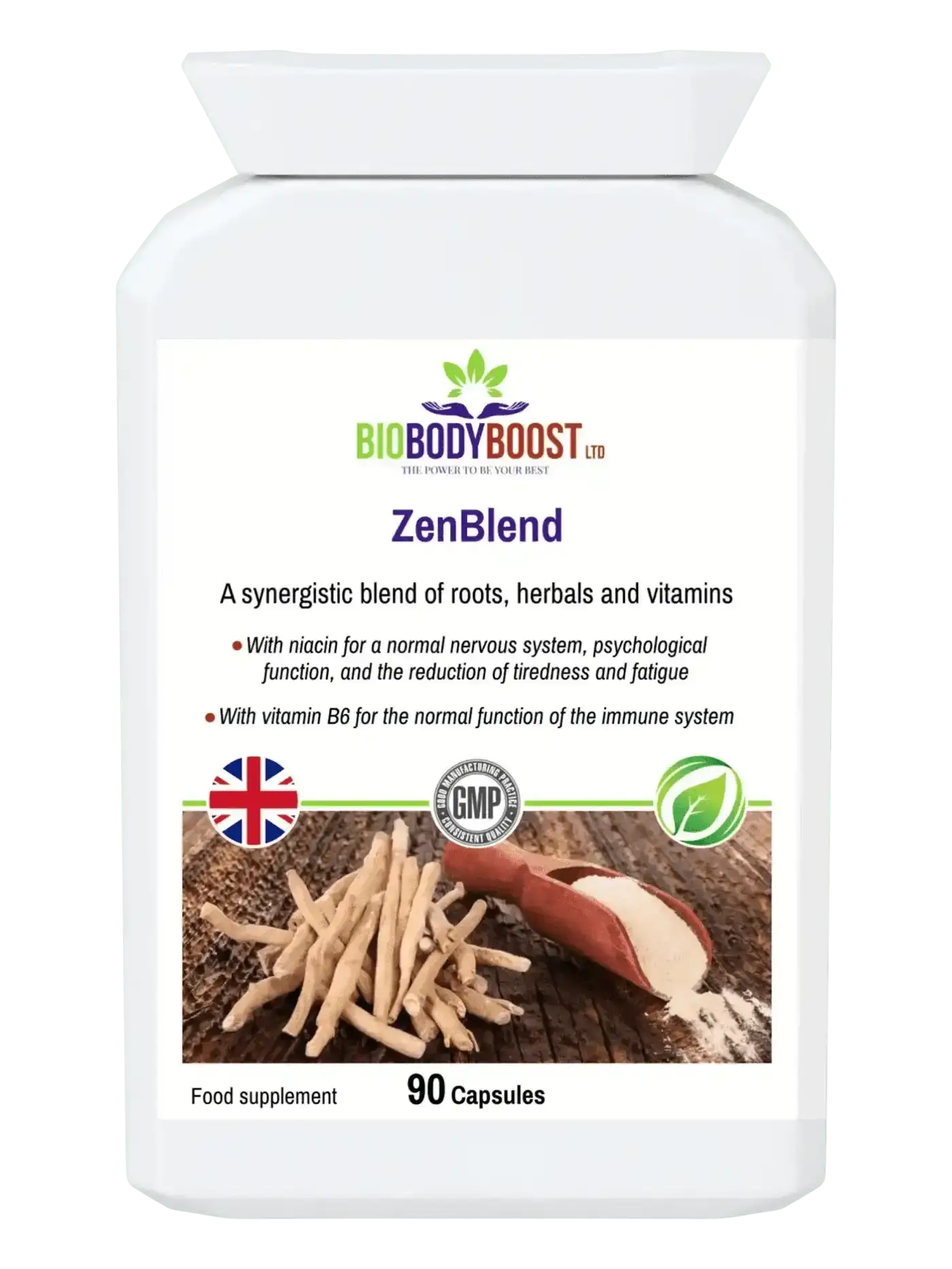
ZenBlend combines a clinically dosed ashwagandha complex with rhodiola, Siberian ginseng, and a full B vitamin complex including niacin (Vitamin B3) — a nutrient that plays a direct role in serotonin synthesis and NAD+ production, the cellular energy currency your brain relies on under chronic stress.
Every ingredient is:
- ✓ Halal certified — HPMC plant capsules, no pork gelatine
- ✓ Vegan and kosher
- ✓ Gluten-free and dairy-free
- ✓ UK-made in GMP-certified facilities
- ✓ Third-party tested for purity and potency
At £15.99 for a 90-capsule supply, ZenBlend makes evidence-based adaptogen support accessible without the premium pricing of comparable stacked formulas.
→ Shop ZenBlend — Multi-Adaptogen Ashwagandha Complex UK
How to Take Ashwagandha for Best Results
Timing
Taking it in the evening with your meal may benefit sleep quality. For daytime focus and energy, morning with breakfast is equally effective.
Duration
Most clinical benefits appear after 4–8 weeks of consistent daily supplementation. Commit to at least 60 days before evaluating results.
Pairing
ZenBlend pairs well with BioBodyBoost's BioSnooze herbal sleep formula for those targeting both stress and sleep. Explore the full Energy & Focus UK collection for a complete adaptogen-based stack.
Who Should Consider Ashwagandha?
- Working professionals under sustained cognitive or emotional stress
- Shift workers and irregular sleepers with disrupted cortisol rhythms
- Athletes and gym-goers seeking faster recovery and improved performance
- Women experiencing hormonal stress — ashwagandha has shown specific benefits for cortisol-driven hormonal disruption
- Anyone experiencing burnout, persistent fatigue, or difficulty switching off in the evening
Ashwagandha is generally well-tolerated with a strong safety profile across clinical trials of up to 12 months. Not recommended during pregnancy. Use with caution if on thyroid medication.
Frequently Asked Questions
How long does ashwagandha take to work?
Most people notice initial effects within 2–4 weeks. The full cortisol-modulating and cognitive benefits typically emerge after 6–8 weeks. Adaptogens work cumulatively — not like stimulants.
Can I take ashwagandha every day?
Yes. Clinical trials have used daily supplementation for up to 12 months without reported adverse effects in healthy adults. Some practitioners recommend cycling (8–12 weeks on, 2–4 weeks off) for long-term use.
Is ashwagandha halal?
The ashwagandha root extract itself is halal. However, many capsule shells use pork gelatine, which is not halal. ZenBlend uses HPMC plant-based capsules and is fully halal certified — the entire formula, not just the active ingredient.
What is the difference between ashwagandha and rhodiola?
Ashwagandha primarily lowers cortisol and modulates the HPA axis — most effective for reducing anxiety, improving sleep, and supporting recovery. Rhodiola reduces mental fatigue and improves cognitive performance under acute stress. They are complementary, which is why the most effective formulas combine both.
Does ashwagandha help with weight?
Indirectly, yes. Chronically elevated cortisol drives visceral fat accumulation and sugar cravings. By lowering cortisol, ashwagandha supports a healthier metabolic baseline. It is not a fat burner, but the cortisol-weight connection is well established.
The Bottom Line
Ashwagandha is one of the most rigorously studied natural compounds in nutritional science, with consistent clinical evidence for cortisol reduction, stress relief, sleep quality, cognitive performance, and physical recovery. The UK market is finally catching up to what the research has shown for years.
The opportunity in 2026 is not just to take ashwagandha — it's to take it correctly: at a therapeutic dose, in a standardised extract, combined with complementary adaptogens that address the full complexity of the modern stress response.
→ Try ZenBlend — UK's Multi-Adaptogen Ashwagandha Complex at £15.99
Always consult your GP or a qualified healthcare professional before starting any new supplement, particularly if you are pregnant, breastfeeding, or taking prescription medication.