
Quick answer: BCAAs and creatine work through completely different mechanisms and address different training goals. Creatine regenerates ATP (your immediate energy currency) — it improves performance on high-intensity, short-duration efforts (sprints, heavy sets). BCAAs provide leucine, isoleucine and valine directly to muscle tissue during training — they reduce muscle protein breakdown during fasted or low-calorie training and provide a leucine signal for muscle protein synthesis. They are not competing choices: creatine is a performance supplement, BCAAs are a recovery and anti-catabolic supplement. Both are halal when sourced correctly. You can stack them.
What creatine does — ATP regeneration
Creatine monohydrate raises muscle phosphocreatine stores. Phosphocreatine regenerates ATP from ADP during the first 8–12 seconds of maximum-intensity effort (the phosphagen system). Creatine supplementation does not build muscle directly — it allows you to do more work at high intensity, which then produces the stimulus for muscle growth. The evidence is the strongest of any sports supplement: over 300 clinical trials confirm creatine significantly improves performance in high-intensity, short-duration exercise.
Typical loading: 3–5g/day (gradual) reaching muscle saturation at 28 days, or 20g/day for 5–7 days (loading) reaching saturation faster. Full creatine loading guide here. Is creatine halal? Yes — synthetic, no animal origin. BioBodyBoost Creatine Monohydrate — 100% pure, halal certified, UK made.
What BCAAs do — protein synthesis signal and anti-catabolism
BCAAs (leucine, isoleucine, valine in 2:1:1 ratio) are three of the nine essential amino acids that the body cannot synthesise and must obtain from diet. Their specific roles:
- Leucine: the most important — directly activates mTORC1 (the master regulator of muscle protein synthesis). Even a small dose of leucine (2–3g) creates a strong anabolic signal regardless of total caloric intake.
- Isoleucine: promotes GLUT4 translocation (glucose uptake into muscle cells) and has mild anti-catabolic activity.
- Valine: competes with other amino acids for blood-brain barrier transport, potentially reducing central fatigue during prolonged exercise.
Howatson et al. (2012, Journal of the International Society of Sports Nutrition, RCT) found BCAA supplementation significantly reduced muscle damage markers (CK, LDH), DOMS severity and performance decrements after a marathon. The anti-catabolic and recovery applications are the most evidence-supported uses of BCAAs.
BCAA honest limitation: if you eat adequate protein (1.6–2.0g/kg/day) from complete protein sources, BCAAs add little because you’re already providing all essential amino acids. BCAAs are most useful when: (1) training fasted or semi-fasted; (2) in a caloric deficit where muscle protein breakdown is elevated; (3) Ramadan training where protein intake is compressed into a short eating window.

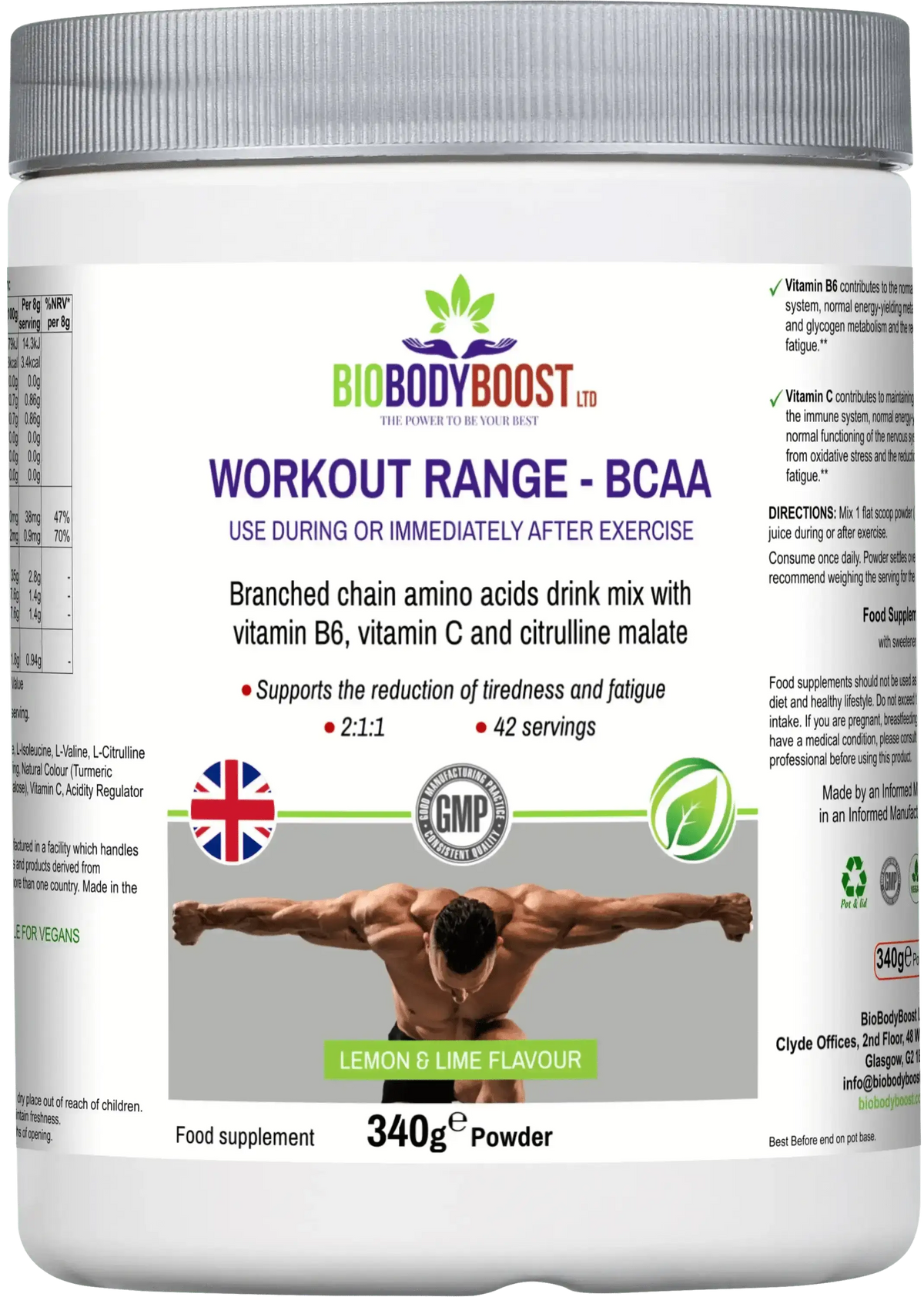
Fermentation-derived aminos, declared per-serving — the sourcing detail that determines halal status.
Halal compliance: BCAAs specifically
BCAAs are the highest-risk amino acid category for halal compliance. They can be derived from:
- Plant fermentation (halal, vegan): bacterial or yeast fermentation of plant sugars produces L-leucine, L-isoleucine and L-valine. Standard for vegan-labelled products. This is the source used by BioBodyBoost.
- Animal sources (requires halal verification): older BCAA production sometimes used animal hair, feathers or collagen hydrolysis. Not vegan. Requires specific halal certification covering amino acid source.
BioBodyBoost BCAA 2:1:1 — fermentation-derived leucine, isoleucine and valine, plus citrulline malate. Halal certified under UHA Certificate Ref. 24623. Vegan.
Can you stack BCAAs and creatine?
Yes — they address completely different mechanisms and there is no interaction between them:
- Creatine: phosphocreatine system, ATP regeneration, performance
- BCAA: mTORC1 leucine signalling, anti-catabolism, recovery
For maximum benefit: take creatine at any time daily (timing matters less than consistency for saturation). Take BCAAs during training (if fasted) or intra-workout to maintain leucine levels during the muscle protein breakdown window. Together they cover performance (creatine) and recovery (BCAA).
Who needs which
| Situation | Priority supplement | Reason |
|---|---|---|
| Strength training, maximum performance | Creatine first | ATP regeneration is the primary limiter for heavy sets |
| Training fasted or during Ramadan | BCAAs first | Anti-catabolism during fasted training preserves muscle |
| Eating adequate protein daily | Creatine only | Dietary protein already provides BCAAs |
| Caloric deficit + training | Both | Creatine maintains performance; BCAAs reduce catabolism |
| Endurance training (marathon, cycling) | BCAAs | DOMS reduction evidence (Howatson 2012), central fatigue valine |
Are BCAAs halal UK?
Fermentation-derived BCAAs are halal — produced by bacterial or yeast fermentation of plant sugars, no animal involvement. Always check the label for “fermentation-derived” or “vegan” and look for third-party halal certification covering the amino acid source specifically (not just the finished product shell). BioBodyBoost BCAA 2:1:1 uses fermentation-derived amino acids and carries full UHA halal certification (Ref. 24623). Animal-derived BCAAs (from feathers or hair) exist in some older formulas — these require halal verification of the specific animal source and slaughter method.
Should I take BCAAs or creatine for muscle gain?
Creatine has significantly stronger evidence for muscle and strength gain — it is consistently the most effective supplement for these goals across 300+ trials. BCAAs alone do not produce significant muscle gain in people eating adequate protein. For muscle gain: creatine 3–5g daily is the priority, alongside adequate total protein (1.6–2.0g/kg/day) from whey or pea protein. BCAAs become useful when protein intake is restricted (caloric deficit, fasted training, Ramadan) where they reduce the muscle protein breakdown that limits growth.
BioBodyBoost — Halal Certified UK Supplements
Use code HALAL10 for 10% off your first order — halal approved under UHA Certificate Ref. 24623, vegan, UK made. Shop halal sports nutrition →