
Quick answer: most people experiencing bloating, gas or digestive discomfort are dealing with one of three underlying issues — insufficient digestive enzyme output, an imbalanced gut microbiome, or inadequate dietary fibre. The supplement categories that address each are digestive enzymes, probiotics and prebiotic fibre. For UK consumers who need vegan and halal-certified options, there is an important compliance issue that almost never gets discussed: most digestive enzyme supplements use pancreatin — derived from porcine (pig) pancreas — which is not halal and not vegan. This guide covers the evidence for each category, what to look for, and why source verification matters more in gut health supplements than almost anywhere else.
Why bloating happens — the three mechanisms
1. Insufficient digestive enzymes
The digestive system produces enzymes to break down proteins (proteases), fats (lipase) and carbohydrates (amylase). When enzyme output is insufficient — from age (pancreatic secretion declines by up to 56% in older adults), stress, alcohol, or specific food intolerances — undigested food reaches the large intestine where bacteria ferment it, producing gas and bloating. The bloating typically occurs 1–3 hours after eating, is related to specific food types, and is worse with larger or richer meals. See the NHS guide to indigestion and bloating.
2. Gut microbiome imbalance (dysbiosis)
The gut microbiome contains approximately 100 trillion microorganisms. When the balance between beneficial bacteria (Lactobacillus, Bifidobacterium) and harmful or opportunistic species is disrupted — by antibiotics, poor diet, stress or illness — the dysbiosis creates disproportionate gas production, altered gut motility and intestinal inflammation. This type of bloating is often more persistent and not simply related to specific meals.
3. Insufficient dietary fibre
UK adults consume on average 18g fibre daily against the 30g NHS recommendation. Insufficient soluble fibre slows gut transit, alters stool consistency and reduces the prebiotic substrate that beneficial bacteria need to produce the short-chain fatty acids that maintain gut barrier integrity. Paradoxically, rapidly increasing fibre intake can temporarily worsen bloating before improving — a gradual increase with adequate water intake is the evidence-based approach.
The halal compliance issue in digestive enzymes — what most labels don’t tell you
This is the most important section for UK Muslim and vegetarian/vegan consumers.
The majority of digestive enzyme supplements on the UK market use pancreatin — a blend of enzymes extracted from the pancreas of pigs (porcine pancreatin). Pancreatin is effective, inexpensive and widely used across pharmacy own-brand and mainstream supplement brands. It contains amylase, lipase and protease in naturally occurring proportions.
Why this matters for halal and vegan consumers: porcine-derived pancreatin is haram. It is also not vegetarian or vegan. The label will say “digestive enzymes” or list the enzyme types without disclosing the porcine source unless you look at the full ingredient list and recognise “pancreatin” or “PD enzyme complex” as animal-derived. Many consumers have been unknowingly taking porcine enzyme supplements for years.
The alternative: plant and microbially derived enzymes. Amylase, protease, lipase, bromelain and papain can all be produced from plant or microbial fermentation sources with equivalent digestive activity to pancreatin. These are inherently vegan and halal-compliant. Look for:
- Bromelain: protease from pineapple (Ananas comosus) — plant-derived
- Papain: protease from papaya (Carica papaya) — plant-derived
- Microbial amylase, protease, lipase: from Aspergillus or Rhizopus fermentation — halal, vegan
- Activity units declared: enzyme strength is measured in activity units (SKB for amylase, HUT for protease, GDU for bromelain) — a product declaring only milligrams cannot be properly evaluated

The back label: activity units declared for every enzyme, not just milligrams — the detail most competitor labels skip.
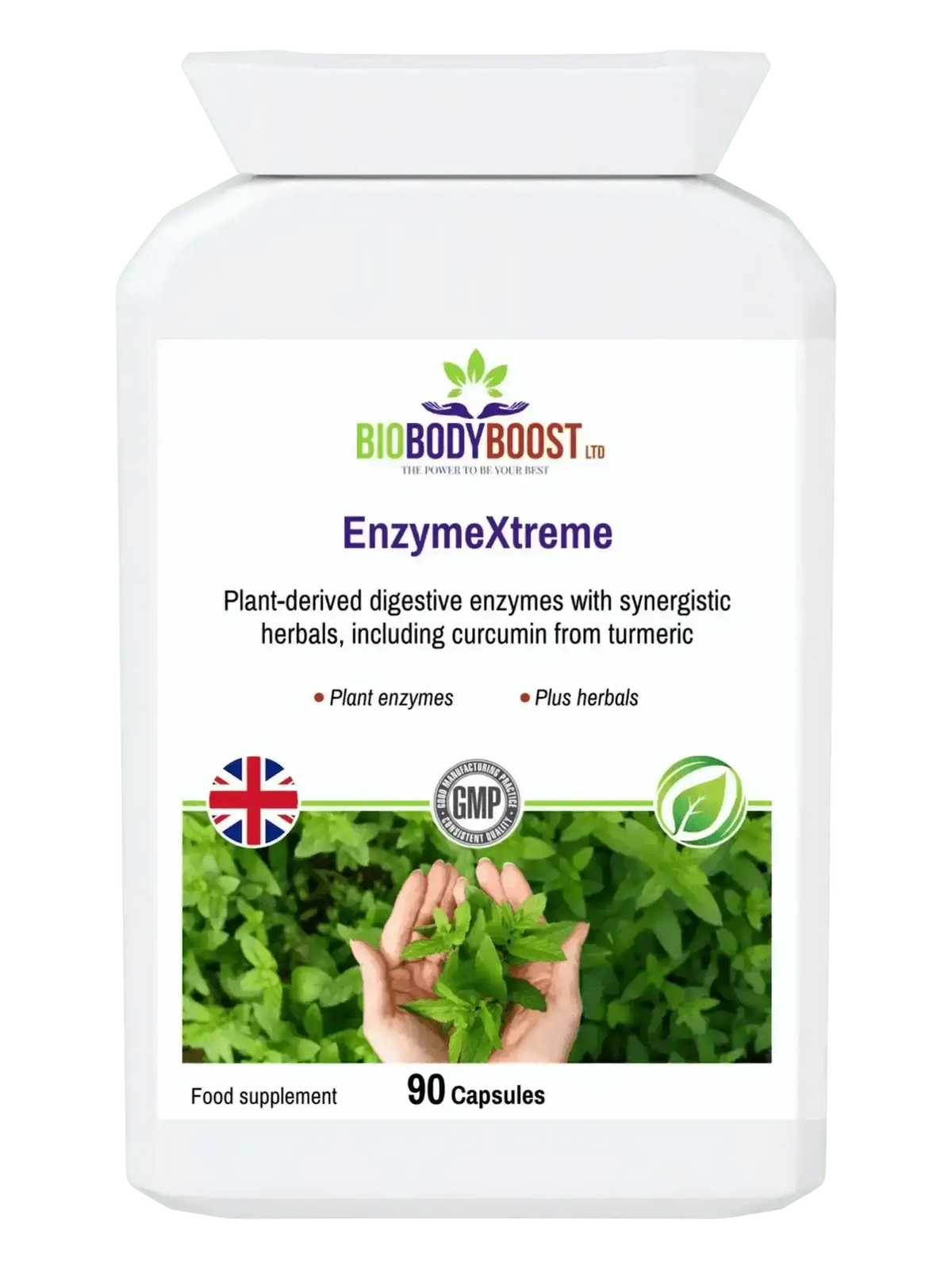
EnzymeXtreme provides 7 plant and microbially derived enzymes with activity units declared, alongside 421mg turmeric (providing 20mg curcuminoids), betaine hydrochloride 145mg, and 7 carminative herbs including fennel, ginger, peppermint, caraway, chamomile and apple cider vinegar. All in an HPMC vegan capsule. Halal and kosher certified. No pancreatin, no porcine source of any kind.
Probiotics for gut health — what the evidence actually shows
Probiotics for general bloating and gut health have a mixed evidence base. The evidence is most consistent for:
- Antibiotic-associated diarrhoea: Hempel 2012 (JAMA, 63 RCTs, n=11,811): 42% risk reduction from probiotics. Start simultaneously with antibiotics, 2 hours apart.
- IBS-C and IBS-D: multiple meta-analyses confirm Lactobacillus and Bifidobacterium strains significantly reduce bloating, pain and altered bowel habits in IBS vs placebo. Consistent use for 8+ weeks produces the most meaningful results.
- Post-antibiotic microbiome restoration: multi-strain probiotics restore microbiome diversity faster than diet alone after antibiotic courses.
For general “bloating” without an IBS diagnosis: the evidence is less consistent. If the bloating is enzyme-related (post-meal, food-specific), enzymes are likely the better intervention. If the bloating is dysbiosis-related (persistent, not meal-specific), probiotics address the root cause more directly. NHS guidance on IBS symptoms and management.
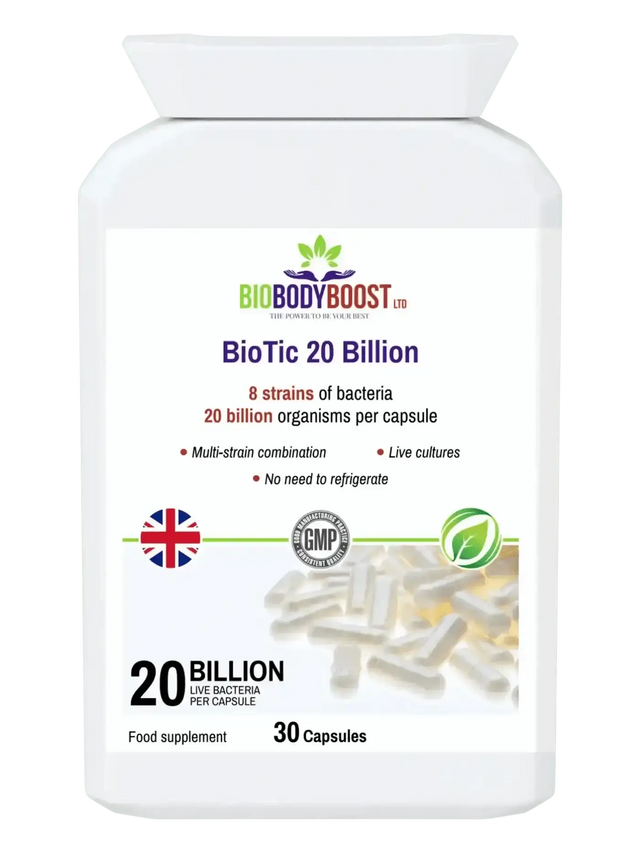
Halal compliance for probiotics: the critical check is the bacterial growth medium — probiotic bacteria are cultured on growth media that can include porcine peptone (from pork). Third-party halal certification covering the growth media is the only meaningful verification. BioTic 20 Billion — 20 billion CFU, 8 named strains, HPMC capsule, halal and kosher certified. Growth media halal-certified.
Prebiotic fibre — the foundation of everything else
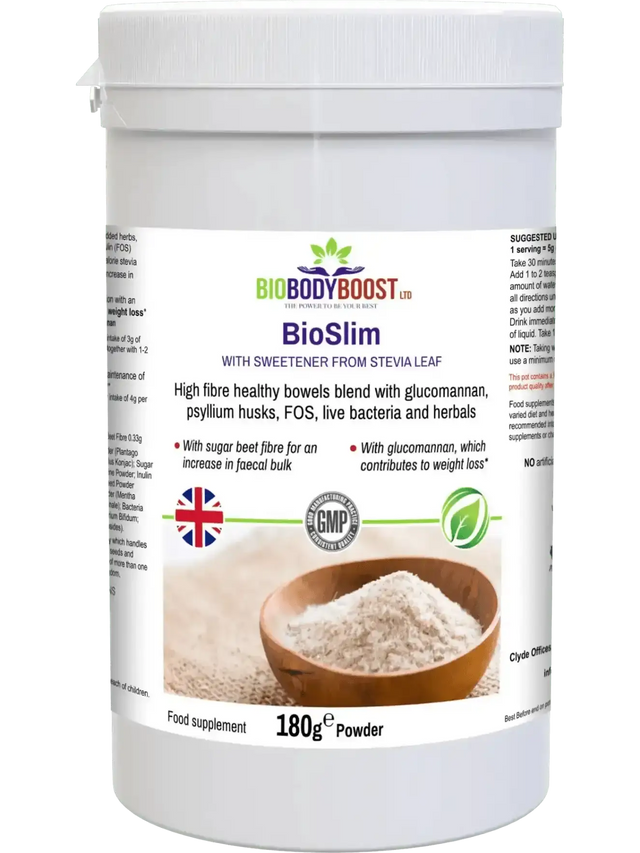
Probiotics need prebiotic substrate to produce the short-chain fatty acids (butyrate, propionate, acetate) that maintain the gut environment. Without adequate fibre, even the best probiotic formula has limited substrate to work with. The EFSA-authorised fibre claims: glucomannan for cholesterol and weight management, psyllium for bowel regularity, sugar beet fibre for faecal bulk. BioSlim — 4 fibres (psyllium, glucomannan, sugar beet, inulin FOS), L-glutamine, live cultures, fennel, peppermint, ginger. 3 EFSA-authorised claims. Halal and kosher certified.
The complete halal vegan gut health stack
| Problem | Supplement | Mechanism |
|---|---|---|
| Post-meal bloating, food-specific | EnzymeXtreme | Plant enzymes break down fats, proteins and carbs before they reach the large intestine |
| Persistent bloating, dysbiosis | BioTic 20 Billion | Multi-strain probiotics restore microbiome balance |
| Slow transit, irregularity, fibre gap | BioSlim | EFSA-authorised fibre blend + prebiotic + live cultures |
| Post-antibiotic + rebuilding | BioSlim + BioTic stack | Prebiotic substrate feeds the probiotic restoration |
Are digestive enzyme supplements halal UK?
Only if specifically certified. Most digestive enzyme supplements use pancreatin — extracted from pig pancreas, inherently haram. The label will say “pancreatin” or list enzyme types without disclosing the porcine source. Plant-derived enzymes (bromelain from pineapple, papain from papaya, microbial amylase/protease/lipase from Aspergillus fermentation) are halal and vegan. EnzymeXtreme from BioBodyBoost uses only plant and microbially derived enzymes, is halal certified under UHA Certificate Ref. 24623, and declares activity units for all enzymes.
What is the best supplement for bloating UK halal?
It depends on the type of bloating: (1) post-meal food-specific bloating — plant-derived digestive enzymes (EnzymeXtreme) taken with the meal address undigested food reaching the large intestine; (2) persistent bloating not related to specific meals — multi-strain probiotics (BioTic 20 Billion) address microbiome dysbiosis; (3) sluggish digestion and low fibre — BioSlim (psyllium + glucomannan + prebiotic fibre) with adequate water. For many people a combination addresses multiple mechanisms simultaneously. All three BioBodyBoost products are halal certified, vegan, HPMC capsule, UK GMP made.
Why is pancreatin in most digestive enzyme supplements?
Porcine pancreatin has been the industry standard since the 1960s — it is inexpensive, effective and provides all three major enzyme types (amylase, lipase, protease) in a single ingredient. The porcine source is rarely disclosed prominently on labels, which means many consumers — including Muslim, Jewish, vegetarian and vegan consumers — take it unknowingly. Plant-derived alternatives (bromelain, papain, microbial enzymes) are slightly more expensive to produce but provide equivalent digestive activity. When buying digestive enzymes, look for the source explicitly stated as plant or fermentation-derived, not just the enzyme type names.
BioBodyBoost — Halal Certified UK Supplements
Use code HALAL10 for 10% off your first order — halal approved under UHA Certificate Ref. 24623, vegan, UK made. Shop gut health UK →