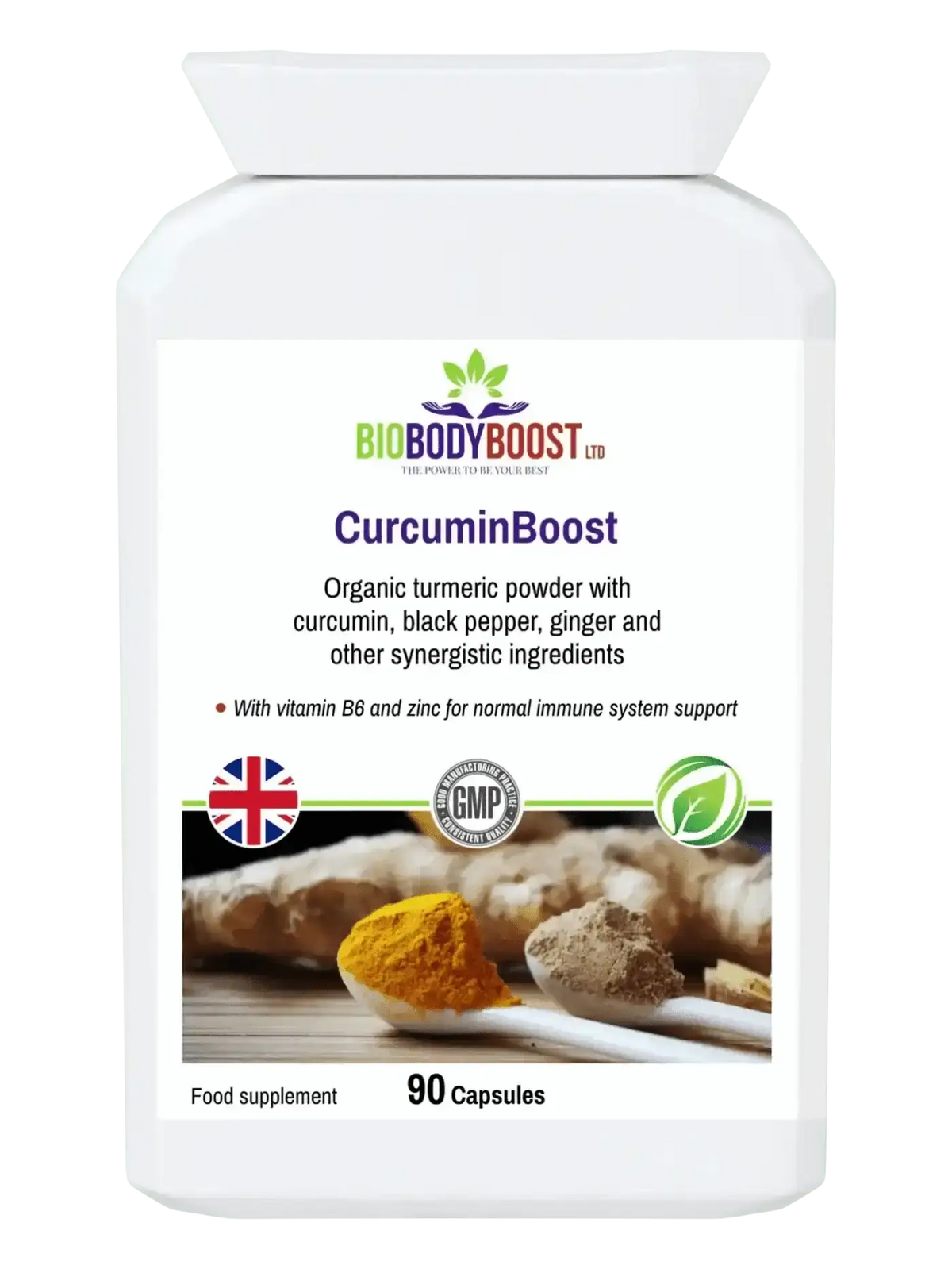
Quick answer: turmeric is a plant root (Curcuma longa), inherently halal with no animal involvement. Curcumin is the primary active compound. The evidence for joints is strong at appropriate doses — but bioavailability is the critical issue. Curcumin alone has extremely poor absorption (approximately 1% bioavailability from the gut). Piperine from black pepper increases curcumin bioavailability by approximately 2,000% and is the essential combination. BioBodyBoost CurcuminBoost provides organic curcuminoids with ginger and black pepper piperine. Halal certified, vegan.
The bioavailability problem
Curcumin is lipophilic (fat-soluble) and rapidly metabolised in the gut wall and liver before reaching systemic circulation. Studies using plain curcumin show approximately 1% oral bioavailability — meaning 99% of what you swallow is excreted. This explains why some people find turmeric supplementation ineffective: they are using the wrong formulation at the wrong dose with no bioavailability enhancer.
The solutions: (1) Piperine (black pepper extract): inhibits CYP3A4 and P-glycoprotein in the gut wall, reducing curcumin first-pass metabolism. Shoba et al. (1998, Planta Medica) found 20mg piperine co-administered with 2g curcumin increased curcumin bioavailability by 2,000% in healthy volunteers. (2) Fat-soluble vehicle: taking curcumin with a fat-containing meal improves absorption. (3) Phytosome or nanoparticle forms: encapsulation technologies with higher bioavailability but typically higher cost.
Joint evidence — the key trials
Kuptniratsaikul et al. (2014, Clinical Interventions in Aging, RCT, n=367) — one of the largest curcumin joint trials — found turmeric extract at 1,500mg/day produced equivalent improvements in knee osteoarthritis WOMAC pain, stiffness and physical function scores to ibuprofen over 4 weeks, with significantly fewer GI adverse events. A 2016 Journal of Medicinal Food meta-analysis (8 RCTs) confirmed curcumin significantly improved joint pain and function vs placebo. A 2019 Phytotherapy Research meta-analysis confirmed significant reductions in inflammatory markers (CRP, IL-6) from curcumin supplementation.
Is turmeric halal?
Yes — turmeric (Curcuma longa) is a rhizome (root) plant. Entirely plant-origin, no animal involvement, no intoxicant properties. Halal, vegan and kosher without qualification. The compliance check is the capsule shell (HPMC = halal; gelatine = check source) and manufacturing environment. CurcuminBoost — 150mg organic curcuminoids + ginger + black pepper piperine. HPMC capsule, halal certified, vegan, kosher. Pair with Flexi-Time (vegan glucosamine + MSM) for the complete halal joint stack. See the full joint supplements halal UK guide.
Does turmeric really help joints?
At therapeutic doses with piperine, yes — the Kuptniratsaikul 2014 RCT (n=367) found equivalent outcomes to ibuprofen for knee OA at 1,500mg/day turmeric extract. The key requirements: (1) standardised curcuminoid content (not just turmeric powder with variable active compound); (2) piperine co-administration (without it, bioavailability is approximately 1%); (3) consistent daily use for 4–6 weeks minimum. The 2016 meta-analysis (8 RCTs) confirmed significant improvements in joint pain and function across trials. Turmeric is not appropriate for acute inflammatory flares or severe OA requiring medical management — but as a chronic daily joint support supplement, the evidence is meaningful.