Quick answer: melatonin is classified as a prescription-only medicine in the UK under the Medicines Act 1968 and cannot legally be included in a food supplement sold here. Any UK-sold supplement claiming to contain melatonin either contains an illegal ingredient or is making a false label claim. If you need melatonin, a GP can prescribe it for jet lag, shift work sleep disorder or circadian rhythm conditions.
Why melatonin is prescription-only in the UK
In the UK, melatonin is regulated by the MHRA (Medicines and Healthcare products Regulatory Agency) as a medicinal product. The licensed product is Circadin® (prolonged-release melatonin 2mg), available on prescription for short-term treatment of primary insomnia in adults over 55. Faster-release melatonin is also prescribable for jet lag and circadian rhythm disruption.
This contrasts sharply with the United States, where melatonin is regulated as a dietary supplement under DSHEA 1994 and sold openly in pharmacies, supermarkets and online at doses ranging from 0.5mg to 10mg+. The same molecule, radically different regulatory category. This is why US supplement brands you find online may list melatonin as an ingredient — they are operating under US rules, not UK medicines law.
Ordering melatonin supplements from overseas for personal import sits in a legal grey area in the UK. It is not a food supplement in UK law — it is an unlicensed medicine. The MHRA does not routinely intercept personal imports, but no consumer protection or quality oversight applies to these products.
What UK night-time supplements can legally contain
UK-compliant sleep supplements are built from three ingredient categories, each with different regulatory permissions:
1. Vitamins and minerals with EU-authorised claims
This is the only category where specific health claims are legally permitted. The following nutrients carry authorised claims directly relevant to sleep and fatigue:
- Magnesium: EU-authorised to contribute to normal muscle function and reduction of tiredness and fatigue — at 15% NRV (≥56.25mg elemental) per serving. Also contributes to normal psychological function and normal functioning of the nervous system.
- Vitamin B6 (pyridoxine): EU-authorised to contribute to normal psychological function, normal functioning of the nervous system, and reduction of tiredness and fatigue.
- Niacin (B3), riboflavin (B2), pantothenic acid (B5): each EU-authorised to contribute to normal psychological function and reduction of tiredness and fatigue.
- Vitamin B12: EU-authorised to contribute to normal neurological function and reduction of tiredness and fatigue.
These claims require the nutrient to be present at ≥15% of the NRV per declared serving. A product listing magnesium at 10mg makes no authorised claim regardless of what the marketing says.
2. Botanicals — traditional use, no authorised health claims
No botanical ingredient has an EU or UK-authorised health claim for sleep. This is not because the evidence does not exist — it is because the EU claims authorisation process has not assessed botanicals for specific health outcomes (a legislative gap that remains unresolved post-Brexit). What this means in practice:
- A UK supplement label cannot legally say ashwagandha “helps you sleep” or that chamomile “supports sleep quality”
- Traditional use descriptions are permitted (e.g. “traditionally used as a relaxant”) under certain conditions
- The honest approach is declaring the botanical, the dose, and the extract standardisation — and letting buyers assess the evidence themselves
The botanicals most commonly included in UK night supplements, with what the research shows:
Ashwagandha (KSM-66® or Sensoril® extract, Withania somnifera): A 2019 RCT in Medicine (Langade et al., n=60) using KSM-66® at 300mg twice daily for 10 weeks found significant improvements in sleep quality (PSQI score), sleep onset latency and total sleep time vs placebo. A 2021 meta-analysis in PLOS ONE (5 RCTs) confirmed ashwagandha significantly improved overall sleep quality and reduced morning sleepiness. The branded extract matters — unbranded ashwagandha root powder at the same mg dose is not equivalent.
Montmorency tart cherry (Prunus cerasus): Naturally high in phytomelatonin (the plant-produced analogue of melatonin) and proanthocyanidins. A 2012 RCT in the European Journal of Nutrition (Howatson et al., n=20) found tart cherry juice concentrate significantly increased melatonin levels in urine and improved sleep duration and quality vs placebo. A 2018 RCT in the American Journal of Therapeutics (Losso et al., n=8) found 8oz tart cherry juice twice daily increased sleep time by 84 minutes in older adults with insomnia. Dose used in trials: 30–60ml concentrated juice or 350–500mg extract equivalent.
L-theanine (from green tea, Camellia sinensis): Amino acid that increases alpha-wave brain activity (associated with relaxed alertness) and reduces cortisol response to stress. A 2019 RCT in Nutrients (Hidese et al., n=30) found 200mg L-theanine/day for 4 weeks significantly improved sleep satisfaction, reduced sleep latency and reduced daytime dysfunction vs placebo.
Passionflower (Passiflora incarnata): A 2011 RCT in Phytotherapy Research (Ngan and Conduit, n=41) found passionflower tea significantly improved subjective sleep quality vs placebo. Extract doses in supplements typically 200–400mg.
Chamomile (Matricaria chamomilla): Contains apigenin, a flavonoid that binds to GABA-A receptors. A 2017 RCT in Journal of Advanced Nursing (Hieu et al.) found chamomile extract 400mg/day for 4 weeks significantly improved sleep quality and daytime functioning in postnatal women with sleep problems.
Lemon balm (Melissa officinalis): GABA-transaminase inhibitor — may increase GABA levels similarly to some anxiolytics. A 2014 study in Nutrients found 600mg lemon balm extract significantly reduced anxiety and improved sleep in adults with mild sleep disturbance.
3. Traditional Herbal Registration (THR) — a separate regulatory route
Products like Kalms Night and Nytol Herbal hold THR registration, which permits specific labelling based on traditional use evidence rather than clinical trial data. THR products are typically single or dual-herb valerian formulations. This is a separate regulatory pathway from food supplements — higher regulatory bar than a supplement, lower than a licensed medicine. THR wording is tightly controlled and product-specific.
Why dose transparency is the most important label signal
A UK night supplement cannot claim to help you sleep. What it can do is declare exactly what is in it, at what dose, using which extract standardisation. That is the information you need to assess whether a formula matches the doses used in trials.
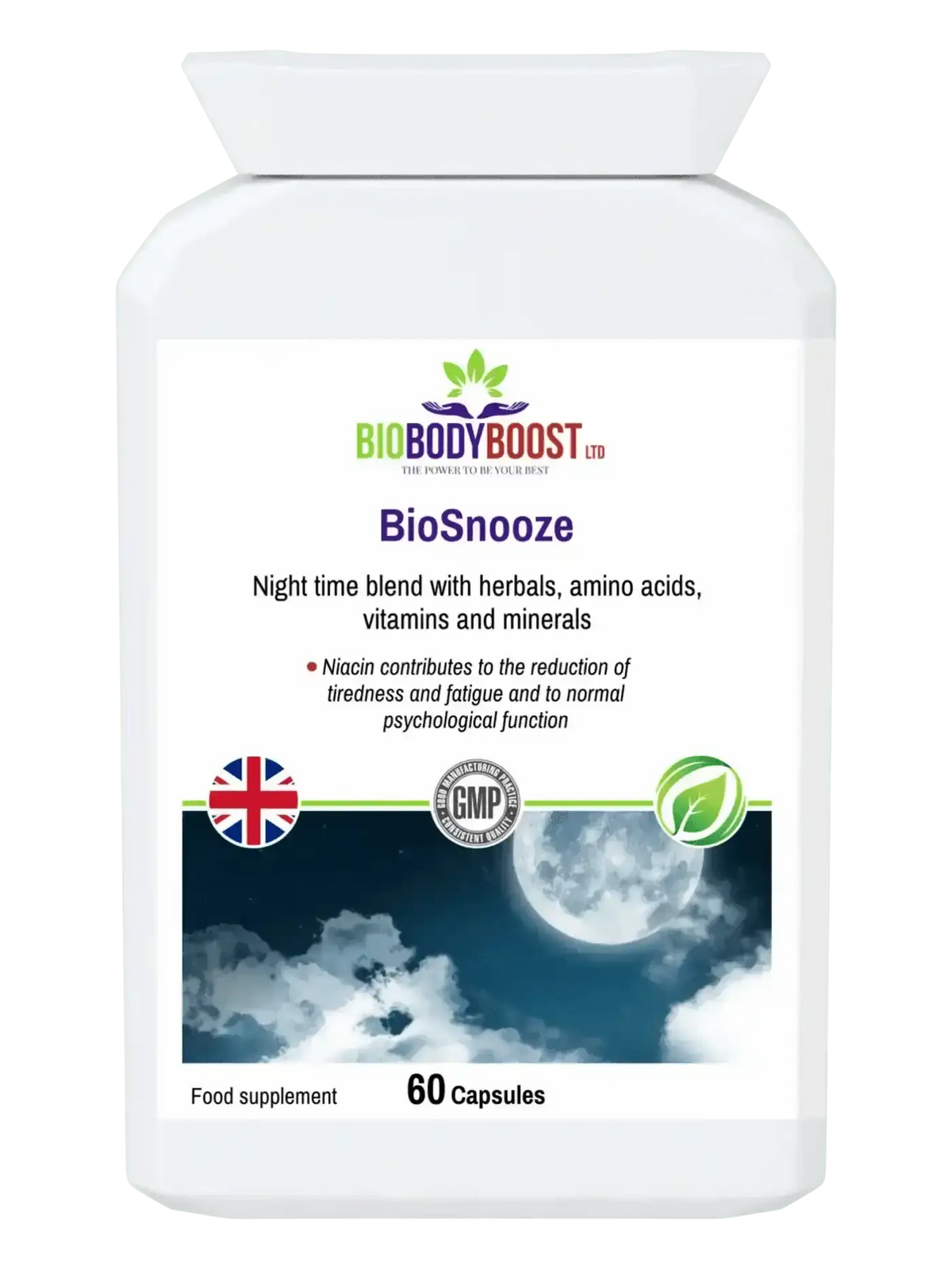
Our BioSnooze declares every ingredient with its dose: 350mg Montmorency tart cherry, 250mg KSM-66® ashwagandha, passionflower, chamomile, lemon balm and lavender, plus L-theanine, L-taurine and five EU-authorised nutrients (magnesium, B6, niacin, pantothenic acid, B12). No melatonin — because it cannot legally be there. Vegan, halal approved, kosher, HPMC capsule.
Can I legally buy melatonin online in the UK?
Melatonin is a prescription-only medicine in the UK — it cannot be legally sold as a food supplement here. Some overseas websites sell it as a supplement under their own country's rules (particularly US-based sites where melatonin is a dietary supplement). Purchasing for personal import sits in a grey area — the MHRA does not routinely pursue individuals importing small quantities, but the product has no UK regulatory oversight for quality, dose accuracy or purity. If you think melatonin would help you, speak to your GP — it is prescribable for jet lag, shift work sleep disorder and circadian rhythm conditions.
What is the difference between melatonin and tart cherry for sleep?
Melatonin is a hormone produced by the pineal gland in response to darkness, signalling the body to prepare for sleep. Tart cherry contains phytomelatonin — a plant-produced analogue of melatonin — as well as proanthocyanidins that may support melatonin metabolism. The 2012 Howatson et al. RCT found tart cherry concentrate significantly increased urinary melatonin levels and improved sleep quality. The melatonin content of tart cherry is much lower than a pharmaceutical melatonin dose, which is why tart cherry is better described as supporting the body's own melatonin production pathway rather than replacing it directly.
Does ashwagandha actually help with sleep?
Yes, with clinical trial evidence. The 2019 Langade et al. RCT (n=60, 10 weeks) found KSM-66® ashwagandha at 300mg twice daily significantly improved PSQI sleep quality scores, reduced sleep onset latency and increased total sleep time vs placebo. A 2021 PLOS ONE meta-analysis of 5 RCTs confirmed the finding. Ashwagandha's sleep benefit is thought to be mediated by its cortisol-reducing (adaptogenic) effect — lower evening cortisol allows natural melatonin to rise. The branded extract (KSM-66®, Sensoril®) matters because standardisation and root/leaf ratio affect the active compound profile.
Is magnesium good for sleep?
Magnesium carries EU-authorised claims for normal muscle function, reduction of tiredness and fatigue, and normal psychological function — not a direct sleep claim, but mechanistically relevant. Magnesium acts as a natural calcium antagonist in the nervous system, reducing neuronal excitability. A 2012 RCT in the Journal of Research in Medical Sciences (n=46) found magnesium supplementation at 500mg/day significantly improved sleep efficiency, sleep time and early morning awakening scores vs placebo in older adults with insomnia. UK dietary surveys show approximately 70% of adults below the RNI for magnesium — making repletion effects meaningful for many people.
Are UK night supplements halal?
It depends on the specific product. Key things to check: capsule material (standard gelatine is often porcine or bovine — HPMC plant-derived capsules are both vegan and halal by capsule material), any animal-derived excipients, and whether the manufacturer operates under halal-certified conditions. BioSnooze uses HPMC capsules and is halal approved — check the current product page for the full allergen and halal statement.