Quick answer: maca (Lepidium meyenii) is a Peruvian root vegetable with a 2,000-year history of use for energy, libido and reproductive health. The clinical evidence supports maca for sexual desire/libido (multiple RCTs), subjective energy and wellbeing, and SSRI-induced sexual dysfunction specifically. It does NOT work via testosterone — maca does not raise testosterone in clinical trials. It works through different pathways (macamides acting on the endocannabinoid system, hypothalamic-pituitary axis modulation). This makes it complementary to zinc (which does affect testosterone in deficient men) rather than competing. Maca is halal: it is a root vegetable with no animal involvement.
What maca actually does — the mechanism
Maca contains unique compounds called macamides (N-benzyl fatty acid amides) that are not found in any other plant. Macamides modulate the endocannabinoid system — specifically inhibiting fatty acid amide hydrolase (FAAH), the enzyme that breaks down anandamide (the body’s endogenous “bliss” molecule). This mechanism produces effects on mood, stress response, sexual function and energy that are independent of testosterone and sex hormone levels.
Secondary mechanisms: maca alkaloids (macaridine) modulate the hypothalamic-pituitary axis, and maca is rich in glucosinolates with thyroid-relevant effects (though at normal supplement doses these are not clinically significant in euthyroid individuals).
What the evidence shows
Sexual desire and libido
Gonzales et al. (2009, Asian Journal of Andrology, double-blind RCT, n=57 men) found 8 weeks of maca supplementation significantly improved self-reported sexual desire vs placebo — without affecting testosterone, LH, FSH or oestrogen levels. This is the critical finding: maca improved libido via testosterone-independent mechanisms. A 2010 CNS Neuroscience and Therapeutics RCT (n=45) found maca significantly improved sexual dysfunction in patients taking antidepressant (SSRI) medication — a specific and practically important application for people experiencing SSRI-induced loss of libido.
Postmenopausal symptoms
A 2006 Menopause RCT (n=14 postmenopausal women) found maca supplementation significantly reduced menopausal symptoms including hot flashes and night sweats vs placebo. A 2008 International Journal of Biomedical Science study confirmed maca significantly reduced depression and blood pressure and significantly improved sexual function in perimenopausal women vs placebo. Both without affecting oestrogen levels — an important finding for women who cannot or prefer not to use HRT.
Energy and wellbeing
A 2009 Journal of Ethnopharmacology randomised trial (cyclists, n=8) found maca supplementation for 14 days significantly improved 40km cycling time trial performance vs placebo, alongside significantly improved subjective sexual desire. The energy mechanism likely involves maca’s high iron and B vitamin content alongside macamide-mediated endocannabinoid effects.
Does maca raise testosterone?
No — and this is the most important thing to understand about maca. Multiple RCTs have measured testosterone levels before and after maca supplementation and found no significant change. The Gonzales 2009 RCT specifically showed libido improvement with no testosterone change. The energy, libido and mood benefits of maca occur via testosterone-independent pathways.
This makes maca a useful complement to zinc (which supports testosterone in deficient men via a direct mechanism) — they address different aspects of male vitality without duplicating mechanism.
Is maca halal?
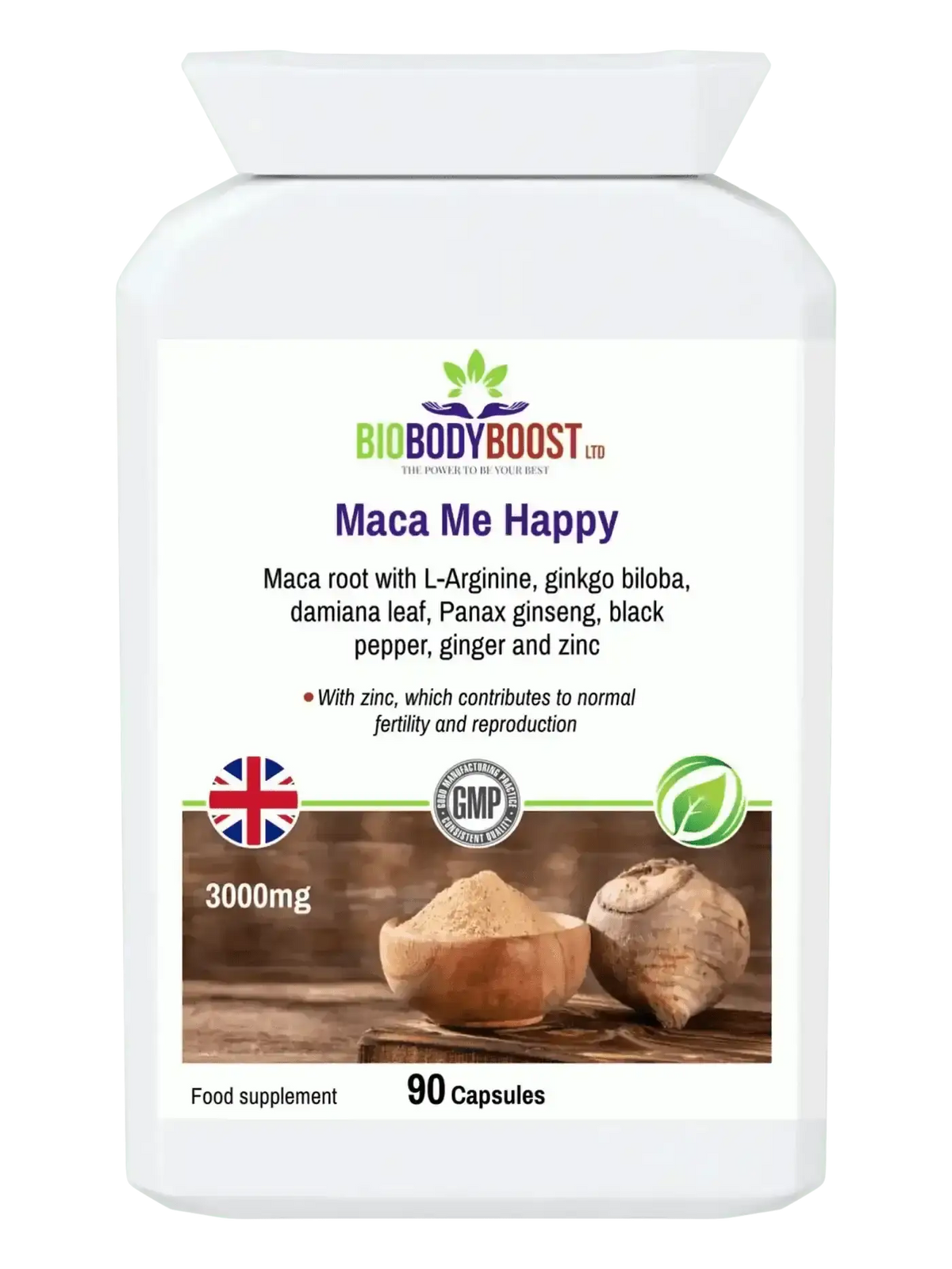
Yes. Maca is a root vegetable in the Brassicaceae family (related to broccoli and cabbage). It is entirely plant-origin with no animal involvement. There are no intoxicant properties — maca does not produce any narcotic or mind-altering effects. It has a long history of use as a food in the Andean region. The halal compliance check for maca supplements is the capsule shell (HPMC = halal) and manufacturing environment certification. Maca Me Happy provides 3,000mg maca root equivalent with zinc 10mg (testosterone support) and Korean ginseng (energy adaptogen) — halal certified, vegan, HPMC capsule.
Does maca root increase testosterone?
No — clinical trials consistently show maca does not significantly affect testosterone, LH, FSH or oestrogen levels. The Gonzales 2009 RCT (n=57) demonstrated this clearly: libido improved significantly over 8 weeks of maca without any testosterone change. Maca’s mechanism is via macamides acting on the endocannabinoid system (FAAH inhibition, anandamide elevation) and hypothalamic-pituitary axis modulation — not via testosterone. For testosterone support in zinc-deficient men, zinc supplementation addresses the direct mechanism. Maca and zinc are complementary for different aspects of male vitality.
Is maca root halal UK?
Yes — maca (Lepidium meyenii) is a root vegetable in the Brassicaceae family. It is entirely plant-origin with no animal involvement and no intoxicant properties. It has been consumed as a food in Peru for 2,000 years. No Islamic scholarly body has ruled maca haram. The compliance check for maca supplements is the capsule shell (HPMC not gelatine) and manufacturing environment. Maca Me Happy uses HPMC capsules and carries full third-party halal certification.
Who should take maca root?
Maca is most evidence-supported for: (1) low libido or sexual desire in both men and women (Gonzales 2009 RCT); (2) SSRI-induced sexual dysfunction (2010 CNS Neuroscience RCT); (3) perimenopausal and postmenopausal women experiencing hot flashes, low mood and sexual symptoms without wanting to use HRT (2006, 2008 RCTs); (4) general energy and vitality support where the adaptogenic and endocannabinoid mechanisms are relevant. Not appropriate as a standalone testosterone booster (it doesn’t raise testosterone). Best combined with zinc if testosterone support is the goal.