Quick answer: D-Mannose is a simple sugar that prevents urinary tract infections (UTIs) by a direct mechanical mechanism — it binds to type-1 fimbriae (the attachment proteins) of E. coli bacteria in urine, preventing them from adhering to bladder wall cells. E. coli coated in mannose are flushed out with urination rather than establishing infection. D-Mannose is not an antibiotic — it does not kill bacteria. It is most effective for recurrent UTIs caused by E. coli (approximately 80–85% of all UTIs). It is plant-derived, inherently halal, and at supplement doses does not significantly raise blood glucose.
Why UTIs keep recurring
Recurrent UTI affects approximately 25% of women who have had one UTI. E. coli from the gut colonises the perineum and ascends the urethra, where it uses type-1 fimbriae to anchor to mannose receptors on urothelial cells lining the bladder. Once anchored it multiplies rapidly, producing the classic symptoms of burning, frequency and urgency. The NHS notes that UTIs are among the most common infections in women and frequently recur. Repeated antibiotic courses select for resistant E. coli strains, making prevention increasingly important alongside treatment.
The mechanism: competitive binding
D-Mannose taken orally is absorbed, circulates briefly in the blood and is excreted unchanged in urine. When D-Mannose is present in urine at sufficient concentration, E. coli fimbriae preferentially bind to the freely available mannose in urine rather than to the mannose receptors on bladder wall cells. Bacteria unable to attach are eliminated with normal urination.
What research shows: Kranjcec et al. (2014, World Journal of Urology, RCT, n=308 women with recurrent UTI) found D-Mannose at 2g daily significantly reduced UTI recurrence over 6 months vs both placebo and nitrofurantoin antibiotic prophylaxis — with significantly fewer side effects than the antibiotic. UTI-free rate: 85% (D-Mannose) vs 60% (placebo). A 2020 European Urology Focus meta-analysis confirmed D-Mannose significantly reduced UTI recurrence across multiple trials.
Does D-Mannose raise blood sugar?
At typical supplement doses (1–2g/day), D-Mannose has minimal effect on blood glucose. It is absorbed and excreted rapidly without significant metabolic conversion to glucose. The Kranjcec 2014 trial (n=308) found no adverse metabolic effects from 2g/day over 6 months. For women with diabetes or PCOS, monitoring blood glucose when starting and discussing with your GP is reasonable precaution — but significant glycaemic impact at supplemental doses is not expected.
Is D-Mannose halal?
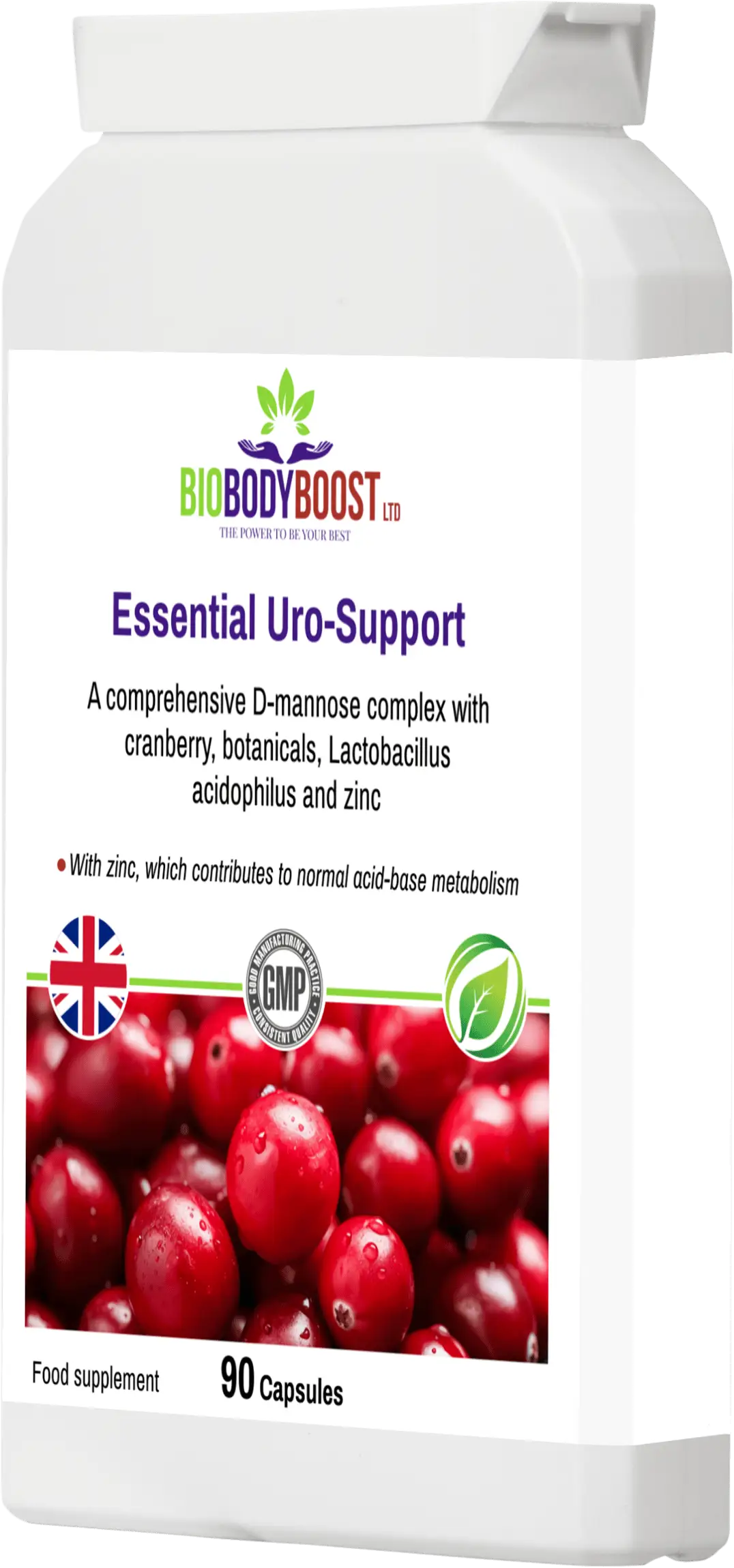
Yes. D-Mannose is a simple sugar found naturally in cranberries, blueberries, apples and peaches. Commercial supplement D-Mannose is produced by enzymatic conversion of glucose from plant starch — no animal involvement. Inherently halal, vegan and kosher. Uro-Support provides 900mg D-Mannose with cranberry extract and probiotic cultures — halal certified, vegan, HPMC capsule, UK GMP. Browse the full Halal Vitamins UK collection.
When and how to take D-Mannose
- Daily prevention: 1–2g with a large glass of water each morning. Consistent daily use maintains urinary D-Mannose levels.
- At first symptoms: 1–2g every 2–3 hours on day 1, then revert to daily maintenance. See your GP if symptoms worsen or don’t improve within 24 hours — D-Mannose does not replace antibiotics for established infections.
- Post-intercourse: one dose after intercourse if intercourse-triggered UTIs are a pattern.
Does D-Mannose really work for UTIs?
For recurrent E. coli UTIs, yes — Kranjcec et al. 2014 (RCT, n=308) found D-Mannose 2g/day significantly reduced recurrence over 6 months, with an 85% UTI-free rate vs 60% placebo. The mechanism is well-characterised: D-Mannose in urine binds E. coli fimbriae, preventing attachment to bladder wall mannose receptors. It does not work against bacteria other than fimbriated E. coli, or against established infections. The NHS recommends GP assessment for UTI symptoms — D-Mannose is a prevention strategy for recurrent E. coli UTI, not a treatment.
Is D-Mannose halal?
Yes — D-Mannose is a plant-derived simple sugar produced from corn starch by enzymatic conversion. No animal involvement at any stage. It is inherently halal, vegan and kosher. The compliance check for D-Mannose supplements is the capsule shell (HPMC not gelatine) and any added ingredients (cranberry, probiotic cultures — all halal in Uro-Support). Full third-party halal certification covers the BioBodyBoost Uro-Support formula.
Can I take D-Mannose during Ramadan?
D-Mannose capsules taken with water during fasting hours: dry capsules with water are considered by most scholars not to break the fast as they provide no nutritional/caloric value to the body in meaningful amounts. However, this is a matter of personal scholarly guidance — taking D-Mannose at Suhoor or Iftar avoids the question entirely and still provides effective prevention, as the urinary excretion of D-Mannose occurs throughout the day from a morning dose.