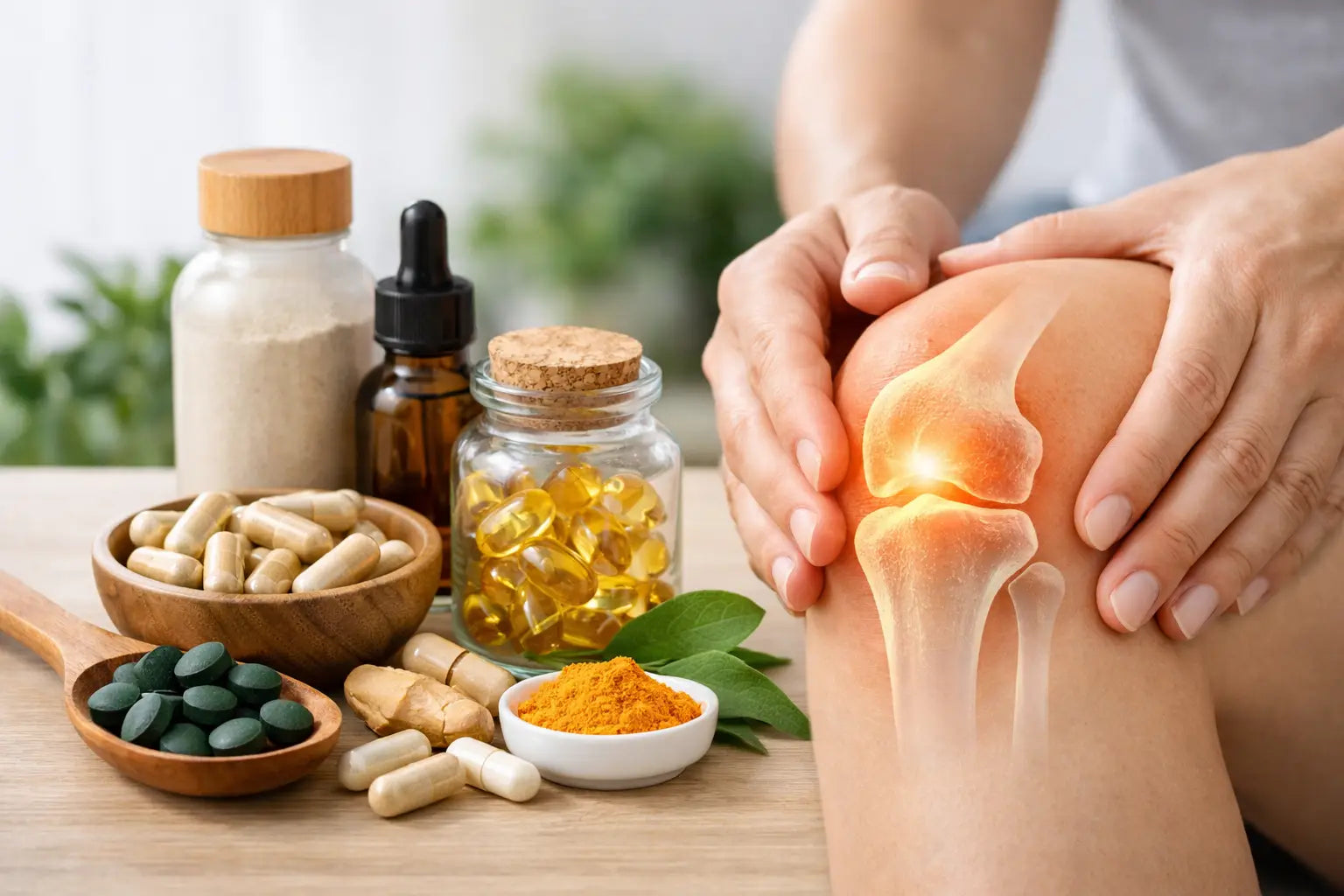
Quick answer: the vegan joint supplements with the strongest clinical evidence are: algae-derived omega-3 EPA+DHA (anti-inflammatory, equivalent to fish oil), vegan glucosamine HCl from fermentation (cartilage support, multiple RCTs), curcumin with piperine or phospholipid delivery (joint comfort, Kuptniratsaikul 2014 n=367), Boswellia serrata extract (AKBA standardised, anti-inflammatory mechanism distinct from NSAIDs), and MSM (methylsulfonylmethane, post-exercise recovery). Vitamin D3 from lichen and magnesium glycinate support the musculoskeletal environment these specific ingredients work in. Most “best vegan joints” articles skip the trial data. This one doesn’t.
1. Algae omega-3 EPA+DHA — anti-inflammatory foundation
Fish oil’s joint benefits come entirely from EPA and DHA — the long-chain omega-3 fatty acids that shift eicosanoid balance away from pro-inflammatory mediators (PGE2, LTB4) and toward anti-inflammatory resolvins and protectins. Algae oil provides the same EPA+DHA directly from the original biosynthetic source — fish accumulate EPA and DHA precisely because they eat algae. The molecule is identical.
What research supports: A 2012 meta-analysis in Annals of the Rheumatic Diseases (Goldberg and Katz, 17 RCTs, n=823) found omega-3 supplementation at 2.7g EPA+DHA/day significantly reduced joint pain intensity, morning stiffness and patient assessment of pain in rheumatoid arthritis vs placebo. A 2017 systematic review confirmed similar effects in osteoarthritis. For vegan athletes with exercise-related joint inflammation, a 2011 AJCN study found 3g EPA+DHA/day significantly reduced exercise-induced inflammation markers (TNF-α, CRP) vs placebo.
Honest limit: most positive trials use 2–3g EPA+DHA/day. Standard 1g omega-3 capsules provide approximately 300mg combined EPA+DHA — far below effective doses. Check combined EPA+DHA content, not total oil volume. Plant-derived ALA from flax and chia has conversion efficiency below 5% to EPA and near-zero to DHA — not a reliable substitute for direct EPA+DHA supplementation for anti-inflammatory goals.
Our OmegaBalance — halal certified. For dedicated algae EPA+DHA: AstaxaKrill combines krill-phospholipid omega-3 with astaxanthin.
2. Vegan glucosamine HCl — cartilage structural support
Glucosamine is a natural component of cartilage and synovial fluid. Standard glucosamine supplements are derived from shellfish chitin. Vegan glucosamine hydrochloride (HCl) is produced via microbial fermentation from corn-derived glucose — chemically identical molecule, no shellfish, halal and vegan.
What research supports: A 2006 New England Journal of Medicine trial (GAIT trial, n=1,583) found glucosamine significantly reduced knee pain in the subgroup with moderate-to-severe osteoarthritis. A 2018 meta-analysis in the British Journal of Sports Medicine (Roman-Blas et al., 10 RCTs) confirmed glucosamine significantly reduced joint pain and improved function vs placebo in knee osteoarthritis, with effects comparable to NSAIDs in some trials. A 2020 Cochrane review confirmed glucosamine sulphate (1,500mg/day) significantly improved pain and function vs placebo across multiple trials.
Form matters: glucosamine sulphate has more trial evidence than glucosamine HCl for osteoarthritis specifically. However, vegan glucosamine is produced as HCl (the fermentation process). The Cochrane review found both forms effective. Effective dose: 1,500mg/day. Timeline: effects typically measurable at 4–8 weeks; full benefit at 12–24 weeks. Do not expect results in days.
Our Flexi-Time combines 1,500mg vegan fermentation-derived glucosamine HCl with MSM, turmeric and vitamin C — halal certified, vegan, non-shellfish.
3. Curcumin (95% curcuminoid extract, bioavailability-enhanced) — joint comfort
Turmeric root powder is not the same as a curcumin supplement. Standard turmeric powder contains approximately 2–5% curcuminoids by weight — a 500mg turmeric capsule provides approximately 10–25mg curcuminoids. Trials showing significant joint benefit use 500–1,500mg curcuminoids with bioavailability enhancement. This is a 20–60x dose difference.
What research supports: A 2014 RCT in the Journal of Alternative and Complementary Medicine (Kuptniratsaikul et al., n=367) compared ibuprofen 1,200mg/day to curcumin extract 1,500mg/day for knee osteoarthritis over 4 weeks. Curcumin produced equivalent improvements in pain on stairs, pain on flat ground and overall pain score to ibuprofen — with significantly fewer GI adverse effects. A 2016 randomised trial (Panahi et al., n=40) found curcumin 1,500mg/day for 6 weeks significantly reduced pain, stiffness and physical function in knee osteoarthritis vs placebo. A 2022 meta-analysis in Frontiers in Medicine (Feng et al., 15 RCTs) confirmed curcumin significantly reduced pain and inflammatory markers in osteoarthritis across all trials.
Bioavailability is critical: curcumin has poor oral bioavailability (≤1% from standard powder). Piperine (black pepper extract, typically 5–20mg alongside curcumin) increases curcumin bioavailability by approximately 20-fold (Shoba et al., 1998, Planta Medica). Phospholipid complexes (Meriva®) and nanoparticle formulations increase it further. Without a bioavailability enhancer, curcumin supplements are largely wasted.
Our CurcuminBoost — 95% organic curcuminoid extract with piperine, halal certified.
4. Boswellia serrata extract (AKBA-standardised) — stiffness and mobility
Boswellia serrata (Indian frankincense) contains boswellic acids, particularly AKBA (acetyl-11-keto-β-boswellic acid), which specifically inhibit 5-lipoxygenase (5-LOX) — the enzyme producing leukotriene inflammatory mediators in joint tissue. This is a distinct anti-inflammatory mechanism from NSAIDs (COX inhibition) and from omega-3 (eicosanoid balance), making Boswellia a genuine complement to these rather than a duplicate.
What research supports: A 2014 Cochrane review found moderate-quality evidence that Boswellia extracts significantly improved pain and function in knee osteoarthritis. A 2019 RCT in Phytomedicine (n=70) found Boswellia extract at 500mg/day for 90 days significantly reduced knee pain, improved walking distance and reduced stiffness vs placebo. A 2015 systematic review confirmed Boswellia produced clinically relevant improvements in pain within 2–4 weeks — faster than glucosamine.
What to look for: AKBA content (minimum 30% AKBA by weight in the extract). Products declaring only “Boswellia extract Xmg” without specifying AKBA standardisation cannot be assessed for potency. Effective dose: 100–250mg AKBA per day from standardised extract.
5. MSM (methylsulfonylmethane) — exercise recovery and collagen cross-linking
MSM provides bioavailable organic sulphur, required for collagen and keratin synthesis (sulphur-containing amino acids cysteine and methionine are structural components of connective tissue). MSM also inhibits NF-κB-mediated inflammatory signalling and reduces oxidative stress markers in exercised tissue.
What research supports: A 2011 RCT in the Journal of the International Society of Sports Nutrition (Withee et al., n=18) found MSM at 3g/day for 28 days significantly reduced post-exercise muscle damage markers (creatine kinase, lactate dehydrogenase) and improved antioxidant capacity. A 2006 pilot RCT (Kim et al., n=50) found MSM at 6g/day for 12 weeks significantly reduced pain and improved physical function in knee osteoarthritis vs placebo. Effective dose: 1,500–3,000mg/day.
6. Vitamin D3 from lichen — musculoskeletal foundation
Vitamin D receptors are present in cartilage, synovial tissue and skeletal muscle. Low vitamin D is associated with increased joint pain, greater cartilage loss in knee osteoarthritis and reduced muscle strength — all of which worsen joint loading and function. UK dietary surveys show approximately 1 in 5 adults clinically deficient October to March. For vegans, food sources are limited; lichen-derived D3 (plant-origin, halal) is the most effective vegan format. Our Lipovita D3+K2 — 4,000 IU lichen-derived D3, liposomal.
7. Magnesium glycinate — muscle tension and recovery
Tight muscles, poor recovery and elevated cortisol all increase the load on joints and worsen perceived joint discomfort. Magnesium regulates NMDA receptor activity (reducing neuronal pain amplification), supports muscle relaxation via calcium antagonism, and has EU-authorised claims for normal muscle function and reduction of tiredness and fatigue. For people whose joint discomfort worsens with stress, training or poor sleep, magnesium glycinate addresses the musculoskeletal context that specific joint supplements operate in.
Matching supplement to symptom pattern
- Ongoing inflammatory joint pain, rheumatoid arthritis: algae omega-3 at 2–3g EPA+DHA/day is the primary intervention, alongside medical management
- Osteoarthritis, cartilage wear, long-term joint protection: vegan glucosamine HCl 1,500mg/day + MSM 1,500–3,000mg/day, 12–24 week commitment
- Stiffness, reduced mobility, morning joint discomfort: Boswellia AKBA-standardised extract for fast effect (2–4 weeks) + curcumin with piperine ongoing
- Exercise-related joint soreness and recovery: MSM + algae omega-3 + magnesium glycinate
- All patterns: ensure vitamin D3 is adequate — test serum 25-OH vitamin D before assuming sufficiency
Browse the full Plant Based Vitamins UK collection for halal certified, vegan joint supplements with declared doses.
Is vegan glucosamine as effective as standard glucosamine?
Vegan glucosamine HCl is chemically identical to shellfish-derived glucosamine HCl — it is the same molecule produced via fermentation rather than shellfish chitin extraction. A 2020 Cochrane review confirmed glucosamine (both sulphate and HCl forms) significantly reduces pain and improves function in knee osteoarthritis vs placebo. The sulphate form has slightly more trial evidence for osteoarthritis specifically, but HCl is effective and is the appropriate vegan format. Effective dose is 1,500mg/day with a 12–24 week commitment — glucosamine is not fast-acting.
Does turmeric actually help joint pain?
Curcumin extract (95% curcuminoids with bioavailability enhancement) does — standard turmeric powder typically does not at capsule doses. The 2014 Kuptniratsaikul RCT (n=367) found curcumin 1,500mg/day equivalent to ibuprofen 1,200mg/day for knee osteoarthritis pain over 4 weeks. The critical distinction: this used curcumin extract at 1,500mg curcuminoids with piperine, not standard turmeric root powder. A 500mg turmeric capsule without bioavailability enhancement provides approximately 10–25mg curcuminoids — 60–150x below the trial dose. Always check for curcuminoid content and piperine or phospholipid complex.
Are vegan joint supplements halal?
The active ingredients in vegan joint supplements are plant or fermentation-derived — inherently halal. The compliance checks: algae omega-3 softgels (the shell is often gelatine — confirm halal-certified shell or HPMC capsule); glucosamine (vegan fermentation source is halal; shellfish-derived requires checking); turmeric/curcumin (plant, halal by source); Boswellia (plant resin, halal); MSM (synthetic, halal). Capsule shell and manufacturing environment certification are the meaningful halal checks for this category. All BioBodyBoost joint supplements use HPMC capsules and carry third-party halal certification.
How long do joint supplements take to work?
It varies significantly by ingredient. Boswellia: 2–4 weeks for noticeable stiffness reduction. Curcumin: 4–6 weeks for meaningful pain reduction in trials. Algae omega-3: anti-inflammatory effects build over 4–8 weeks of daily consistent use; most RCTs measure outcomes at 12 weeks. Glucosamine: 8–12 weeks minimum for structural cartilage effects; the GAIT trial ran 24 weeks. MSM: 4–6 weeks for exercise recovery benefit. Set realistic minimum timelines per ingredient and do not switch products within the first 8 weeks — the most common reason joint supplements “don’t work” is stopping during the pre-effect period.