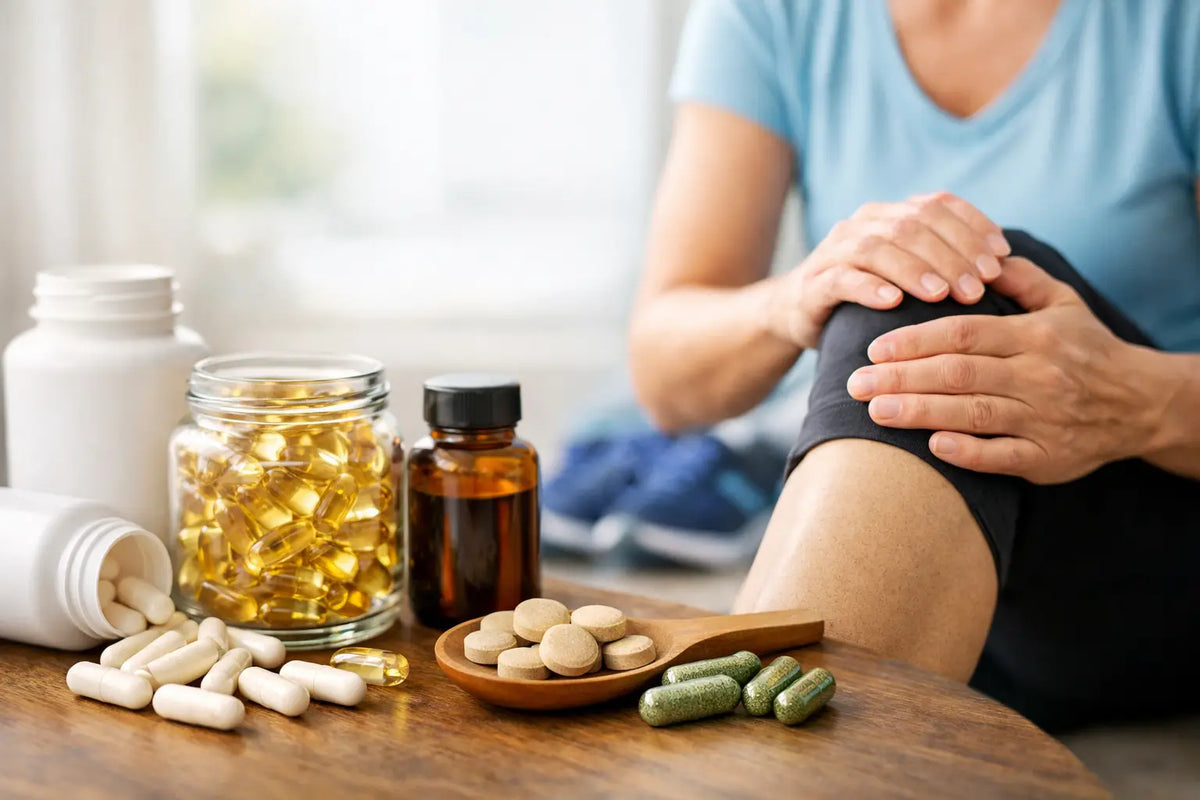
Joint stiffness follows a pattern. It shows up after rest, builds through repetitive load, and tends to get harder to ignore once it disrupts sleep or training. The question most people get stuck on is not whether to take something — it is what, at what dose, and with realistic expectations about what supplements can and cannot do.
This guide covers the ingredients with the most consistent evidence behind them, the doses used in research, and where the honest limits are.
What does the evidence actually show?
A 2021 systematic review in Nutrients found curcumin supplementation significantly reduced pain and improved function in knee osteoarthritis patients compared to placebo across multiple trials, with effects comparable to ibuprofen in some protocols. A 2018 Cochrane review of glucosamine and chondroitin found modest but real effects on pain in knee OA, though results varied by product quality. Omega-3 fatty acids have consistent evidence for reducing inflammatory markers (IL-6, CRP) in meta-analyses, with joint-relevant benefits clearest at doses above 2g EPA+DHA per day.
The honest caveat: most trials run 8–24 weeks, use standardised extracts, and include people with existing joint problems. Extrapolating to prevention in healthy people is reasonable but not perfectly supported.
1. Curcumin (from turmeric)
The research-active compound in turmeric is curcumin, not turmeric powder itself. Curcumin has poor oral bioavailability — studies estimate roughly 1% absorption from standard powder. Formulations that improve this include piperine combinations (BioPerine), phytosome complexes (Meriva), and nanoparticle delivery.
What research supports: A 2019 RCT in Trials (Kuptniratsaikul et al.) used 1,500mg/day of turmeric extract and found equivalent pain reduction to 1,200mg/day ibuprofen in knee OA over 4 weeks. Most trials use 500–1,000mg curcumin equivalents with a bioavailability enhancer.
Honest limit: Effects are clearest in people with existing inflammation. Preventive use in people without symptoms is plausible but understudied. Not a replacement for NSAIDs in acute flares.
See our guide on turmeric vs curcumin bioavailability for what to check on a label before buying.
2. Glucosamine (vegan/halal form)
Glucosamine is a structural component of cartilage. Traditional glucosamine HCl and glucosamine sulphate are almost universally shellfish-derived, which disqualifies them for vegan and halal buyers without careful sourcing. Fermentation-derived glucosamine is the clean alternative — chemically identical, but produced without crustacean shells.
What research supports: The 2006 GAIT trial (NIH-funded, n=1,583) found glucosamine sulphate at 1,500mg/day reduced pain more than placebo in a subgroup with moderate-to-severe knee OA. Longer-term use (Pavelká et al., 2002) showed structural preservation on X-ray over 3 years at 1,500mg/day. Effects on mild OA are less clear.
Honest limit: Works best in moderate-to-severe OA; results in mild cases or younger active adults are inconsistent. Typically needs 6–8 weeks before effects are noticeable.
Our Flexi-Time uses non-shellfish vegan glucosamine HCl with MSM — one of the few halal-friendly glucosamine formulas available in the UK.
3. Boswellia serrata
Boswellic acids (specifically AKBA — acetyl-11-keto-β-boswellic acid) are the active fraction. Boswellia inhibits 5-lipoxygenase (5-LOX), an enzyme involved in leukotriene production and joint inflammation. This is a different pathway to curcumin, which is why combining the two makes pharmacological sense.
What research supports: A 2003 RCT in Phytomedicine (Kimmatkar et al., n=30) using 333mg Boswellia extract three times daily found significant reductions in knee pain and improved joint flexion vs placebo after 8 weeks. A 2011 meta-analysis confirmed clinically significant pain reduction across 7 trials.
Honest limit: Most consumer products do not disclose AKBA content, which is the standardised fraction used in trials. Bioavailability is fat-dependent — take with a meal.
4. MSM (methylsulfonylmethane)
MSM provides bioavailable sulphur, which the body uses in disulphide bonds in collagen and connective tissue. It is commonly paired with glucosamine because the two support different structural elements.
What research supports: A 2006 RCT in Osteoarthritis and Cartilage (Kim et al., n=50) used 3g MSM twice daily (6g/day total) and found significant pain reduction and functional improvement vs placebo at 12 weeks.
Honest limit: Most consumer doses are below the 6g/day used in the strongest trials. MSM is well-tolerated but dose-sensitive — the clinical dose is higher than most product labels suggest.
5. Omega-3 (EPA and DHA)
Omega-3s reduce prostaglandin synthesis via COX pathways — the same mechanism targeted by NSAIDs, but less potently and without GI side effects at normal doses. The relevant compounds are EPA and DHA specifically.
What research supports: A 2012 meta-analysis in Pain (Goldberg and Katz, 17 RCTs) found omega-3 supplementation significantly reduced joint pain intensity and morning stiffness, with stronger effects above 2g EPA+DHA/day used for at least 3 months.
Honest limit: Check the label for combined EPA+DHA, not just total omega-3 or total fish oil. A standard 1g fish oil capsule may contain only 300mg EPA+DHA. Plant-based algae oil delivers DHA more reliably than ALA conversion. Full comparison in our omega-3 guide.
Our OmegaBalance covers omega 3, 6 and 9 in one formula.
6. Vitamin C
Vitamin C (ascorbic acid) is EU-authorised to contribute to normal collagen formation for the normal function of cartilage. This is a structure-support claim, not a pain-relief claim.
What research supports: Vitamin C is a required cofactor for hydroxylation of proline and lysine in collagen synthesis — established biochemistry. Deficiency directly impairs collagen repair. A 2021 review in Nutrients found supplementation above 200mg/day supported collagen synthesis markers in human trials.
Honest limit: If your diet includes consistent fruit and vegetables, you are unlikely to be deficient. Supplemental vitamin C is most relevant for high-volume athletes or restricted diets. It supports building material, not pain management directly.
A food-form option like Bio-C is gentler on the stomach than high-dose ascorbic acid.
7. Vitamin D
Vitamin D3 is EU-authorised to contribute to normal muscle function and maintenance of normal bones. UK surveys (NDNS 2019) show approximately 20% of adults have vitamin D levels below 25 nmol/L in winter — clinical insufficiency.
What research supports: Low vitamin D status is associated with increased musculoskeletal pain in observational data. A 2014 RCT in PAIN found significant pain reduction after 3 months supplementation in deficient patients with chronic widespread pain.
Honest limit: Vitamin D does not reduce joint inflammation directly. Its relevance is indirect — muscle function and bone density influence how comfortably joints move and load. Effects are most reliable in people with confirmed insufficiency.
Full context: vitamin D deficiency in the UK.
8. Magnesium
Magnesium is EU-authorised to contribute to normal muscle function and maintenance of normal bones. Its joint relevance is indirect: tight or poorly recovering muscles alter joint mechanics, load distribution and range of motion.
What research supports: A 2020 systematic review in Nutrients found magnesium supplementation reduced muscle cramp frequency and severity. UK dietary surveys suggest around 70% of adults consume below the reference nutrient intake for magnesium (300mg/day men, 270mg/day women).
Honest limit: Magnesium does not treat joint disease or reduce joint inflammation. It is relevant where muscle tightness or poor recovery is contributing to restricted movement — not a primary joint supplement.
More on forms and dosing: magnesium guide.
9. Ginger extract
Ginger's active compounds (gingerols, shogaols) have demonstrated anti-inflammatory activity via NF-κB and COX-2 pathways. Human evidence is thinner than for curcumin.
What research supports: A 2015 meta-analysis in Osteoarthritis and Cartilage (5 RCTs) found ginger supplementation produced statistically significant but modest pain reduction in knee OA vs placebo. Effect sizes were smaller than curcumin trials.
Honest limit: Human evidence is modest and trials are small. Ginger is a reasonable add-on in a multi-ingredient formula, not a standalone primary intervention.
How to match ingredients to your situation
- Post-workout or training-related stiffness: curcumin (with bioavailability enhancer) + omega-3 at 2g+ EPA+DHA/day. Both address inflammatory pathways most relevant to exercise load.
- Morning stiffness, desk-related or age-related: glucosamine 1,500mg/day + boswellia + curcumin. Covers cartilage support and inflammatory modulation simultaneously.
- Tendons and ligaments specifically: vitamin C is the EU-authorised claim for collagen formation in cartilage — most relevant for runners and lifters with connective tissue issues.
- Muscle tightness contributing to stiffness: magnesium as a foundation, with vitamin D if you have not been outdoors consistently.
Browse the full Joint & Flexibility collection for halal-friendly, non-shellfish formulas with declared ingredients.
What supplements cannot do
Supplements do not rebuild cartilage that has worn away, reverse structural joint changes, or replace medical treatment for inflammatory arthritis. They work alongside sleep, movement, load management and diet — not instead of them. If joint pain is persistent (more than a few weeks), involves visible swelling, limits weight-bearing, or wakes you at night, see a GP before starting a supplement routine.
How long before joint supplements start working?
Most joint ingredients need 6–12 weeks of consistent daily use before effects are noticeable. Curcumin and omega-3 can produce early changes in inflammatory markers within 2–4 weeks in some trials, but functional improvements typically take longer. Glucosamine trials that showed structural effects ran for 6–36 months. Set a realistic minimum of 8 weeks before evaluating results.
Can I take curcumin and boswellia together?
Yes — they work via different anti-inflammatory pathways (curcumin via NF-κB/COX-2; boswellia via 5-LOX), so combining them is pharmacologically rational. Several clinical trials have used both together with positive results. No known negative interactions between the two. Both are better absorbed with food due to fat solubility.
Is vegan glucosamine as effective as shellfish glucosamine?
Fermentation-derived glucosamine HCl is chemically identical to shellfish-derived glucosamine HCl — the source affects allergen status, not the molecular structure. Most major clinical trials used glucosamine sulphate (not HCl), so there is some debate about whether the sulphate form adds benefit. The practical difference in everyday joint support is likely small; the allergen and lifestyle difference is significant.
What dose of omega-3 is needed for joint benefit?
Trials showing joint benefits typically used 2–4g of combined EPA+DHA daily, not total omega-3 or total fish oil. A standard 1g fish oil capsule may contain only 300mg EPA+DHA. Check the actual EPA+DHA figures on the label, not the fish oil weight. This is the most common reason people do not see results from omega-3 for joints — the dose is lower than the clinical evidence requires.
Do joint supplements interact with medication?
High-dose omega-3 (above 3g/day EPA+DHA) may increase bleeding risk, particularly with anticoagulants like warfarin. Curcumin at high doses can affect cytochrome P450 enzymes and may interact with blood thinners and some chemotherapy drugs. Glucosamine may affect blood glucose regulation in people with diabetes. If you take regular medication, check with a GP or pharmacist before starting any joint supplement.
Are these supplements halal?
It depends on source and manufacturing. Most glucosamine is shellfish-derived and not suitable without halal-certified sourcing. Gelatine capsules are not halal unless from a halal-certified source. Our Joint & Flexibility range uses HPMC (plant-derived) capsules and non-shellfish glucosamine where applicable — check each product page for current halal status.