The UK anti-aging supplement market is worth hundreds of millions annually — yet for Muslim consumers, the most popular category (collagen) is frequently non-compliant. Most collagen sold in the UK is porcine or uncertified bovine. Marine collagen from halal fish sources, paired with liposomal vitamin C as the collagen synthesis cofactor, is the evidence-based halal anti-aging skin stack. This guide covers the science, the compliance and the products.
Why skin ages — the collagen decline
Skin is approximately 75–80% collagen by dry weight. Collagen (primarily type I and III) provides structural support — the scaffolding that keeps skin firm, elastic and hydrated. From approximately age 25, collagen production declines at approximately 1–1.5% per year. By age 50, skin collagen density has fallen by approximately 30%. The visible results: increased laxity, fine lines deepening into wrinkles, reduced skin bounce and thinner skin texture.
Ultraviolet radiation (even in UK levels) significantly accelerates collagen degradation via matrix metalloproteinase (MMP) enzyme activation. South Asian skin has higher melanin (natural SPF protection) but still accumulates UV-induced collagen damage, particularly around the face. The hyperpigmentation common in South Asian skin (melasma, post-inflammatory hyperpigmentation) has a collagen and skin barrier component alongside its melanin component.
Marine collagen at 9g — the dose the evidence supports
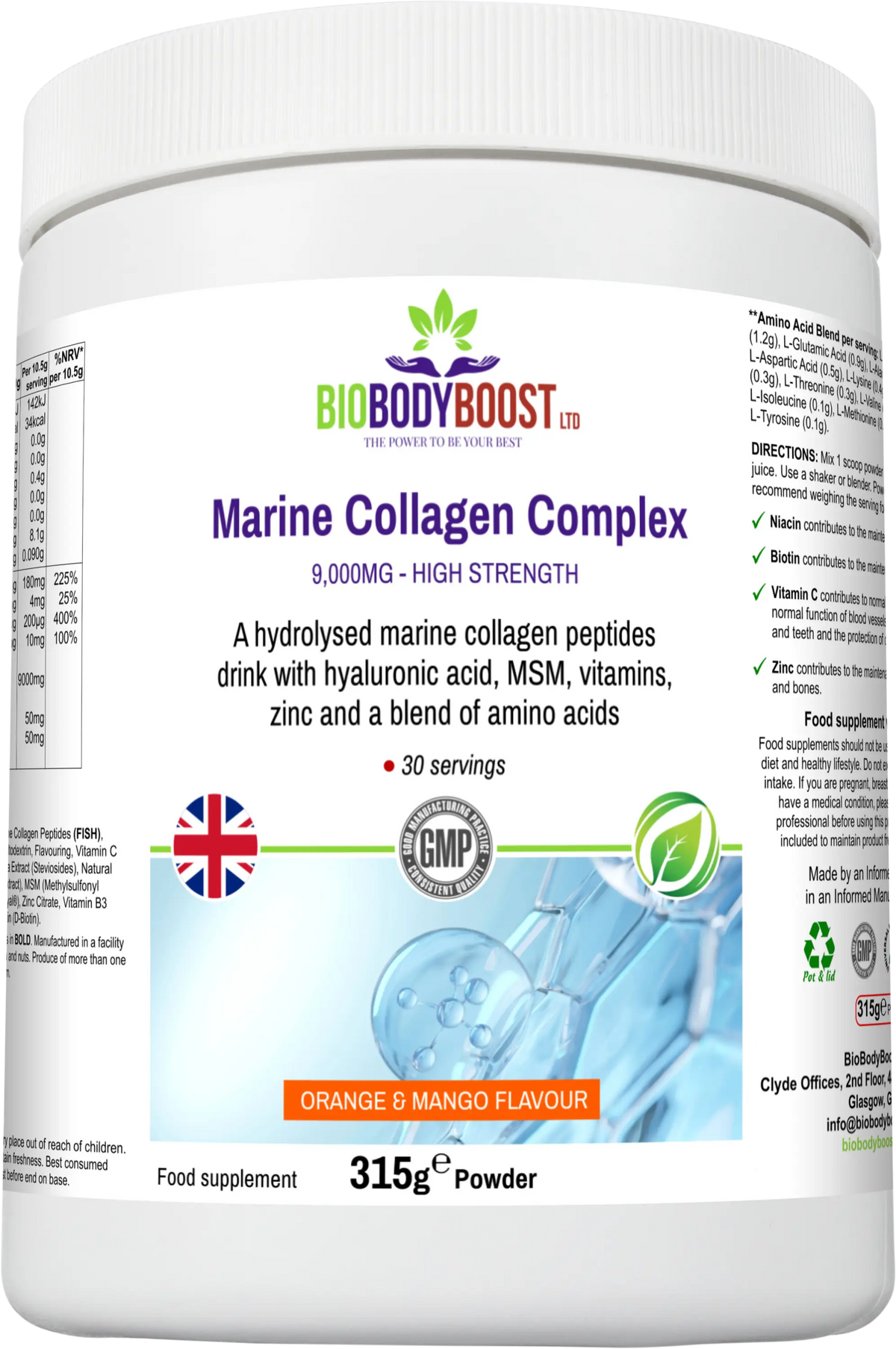
Proksch et al. (2014, Skin Pharmacology and Physiology, n=69): collagen peptides at 2.5g/day for 8 weeks significantly improved skin elasticity vs placebo. Asserin et al. (2015, JEADV, n=105): 10g collagen hydrolysate daily for 8 weeks significantly increased dermal collagen density and skin hydration. A 2019 systematic review in the Journal of Drugs in Dermatology (11 studies) confirmed oral collagen supplementation significantly improved skin elasticity, hydration and dermal collagen density. The effective dose range across trials is 2.5–10g/day — BioBodyBoost Marine Collagen provides 9g per 11g serving, at the upper end where evidence is strongest. Marine Collagen Powder — 9g per serving, halal certified, from halal fish species, UK GMP. Mix with water, juice or smoothie.
Vitamin C — the non-negotiable pairing
Vitamin C (ascorbic acid) is a mandatory cofactor for prolyl hydroxylase and lysyl hydroxylase — the enzymes that hydroxylate proline and lysine residues in procollagen chains. These hydroxylation steps are required for collagen triple helix formation and crosslinking (collagen stability). Without adequate vitamin C, the body cannot synthesise properly structured collagen regardless of how much collagen peptide is consumed. The NHS confirms vitamin C is essential for the maintenance of normal skin.
Liposomal vitamin C encapsulates ascorbic acid in phospholipid liposomes, significantly improving bioavailability vs standard ascorbic acid. Carr et al. (2016, Nutrients) found liposomal vitamin C produced significantly higher plasma vitamin C than standard oral vitamin C at equivalent doses. Liposomal Vitamin C Complex — 500mg per 5ml serving in 300ml liquid, halal certified, vegan.
The halal anti-aging skin stack
| Supplement | Skin mechanism | Dose |
|---|---|---|
| Marine Collagen | Direct collagen peptide delivery + dermal density | 9g daily (1 serving) |
| Liposomal Vitamin C | Cofactor for collagen synthesis enzymes | 500mg daily |
| AstaxaKrill | Mitochondrial membrane antioxidant + UV protection | 1 capsule daily |
Is collagen halal UK?
Marine collagen from fish with fins and scales is halal — fish are permitted under all Sunni schools. Porcine collagen is haram. Bovine collagen requires certified dhabiha slaughter confirmation. BioBodyBoost Marine Collagen uses collagen from halal-certified fish species with full third-party halal certification covering the production process. See the full is collagen halal UK guide.